
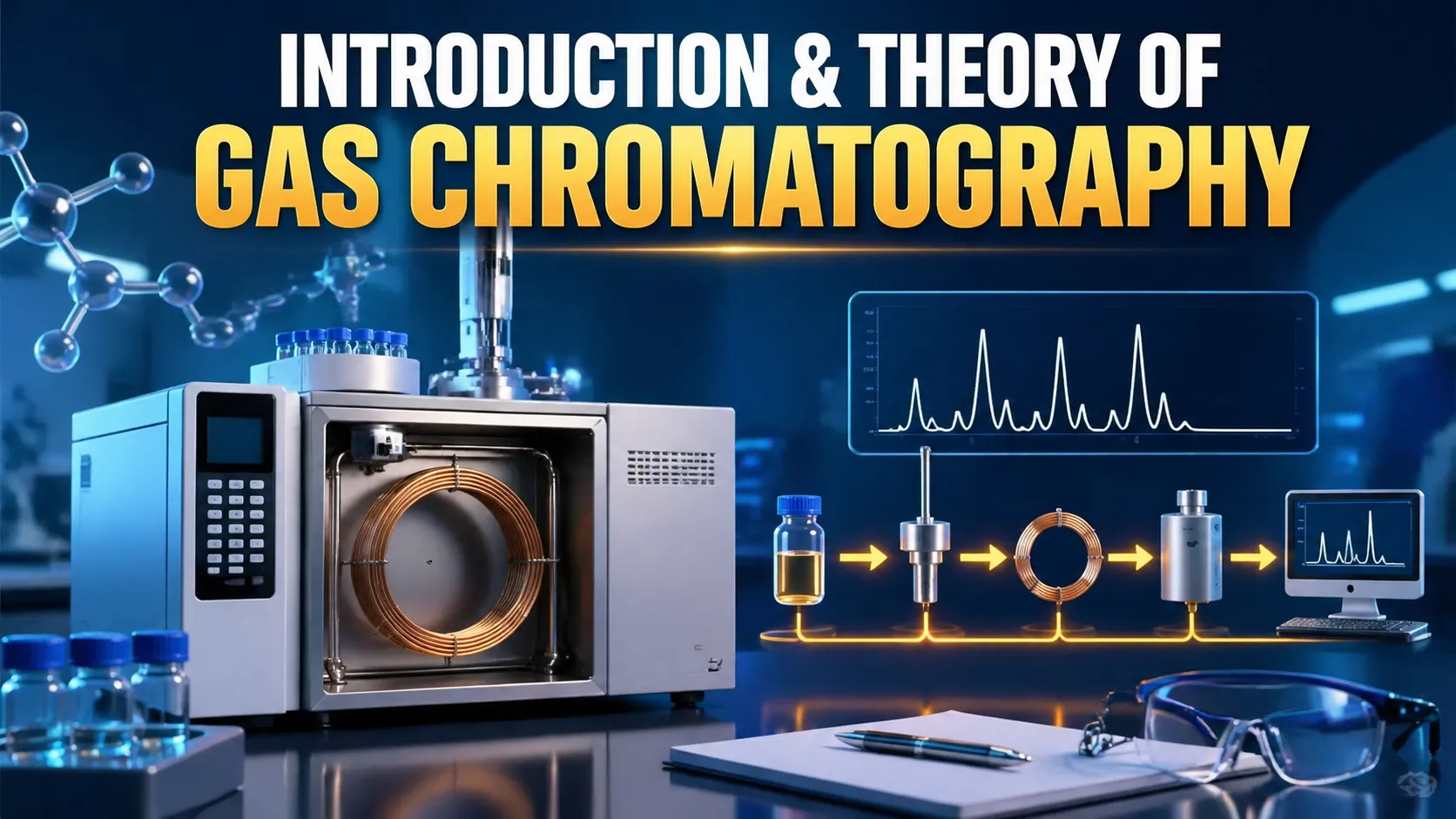
Introduction and Theory of Gas Chromatography explains separation of volatile compounds using a gaseous mobile phase and stationary phase.
Introduction & Theory of Gas Chromatography
- Gas Chromatography (GC) is an analytical technique used to separate, identify, and quantify compounds in a mixture based on their volatility and interaction with a stationary phase.
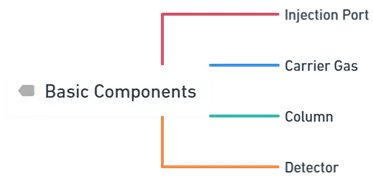
Basic Components
Advertisements
- Injection Port: Where the sample is introduced, usually vaporized into a gaseous state.
- Carrier Gas: An inert gas (like helium, hydrogen, or nitrogen) that pushes the sample through the column.
- Column: A long, coiled tube where separation occurs. The inside of the column is coated with a stationary phase, which can be a liquid film or a solid support.
- Detector: Detects compounds as they elute (come out) from the column. Common detectors include the Flame Ionization Detector (FID) and the Thermal Conductivity Detector (TCD).
Principle
- The sample is vaporized and introduced into the GC. As the sample travels through the column, individual compounds interact differently with the stationary phase, leading to varying travel times.
- More volatile compounds or those with lesser interaction with the stationary phase will elute faster, while less volatile compounds or those with more interaction will elute slower.
Applications
- Widely used in pharmaceuticals, petrochemicals, environmental testing, and food and beverage industries.
- Analyzes volatile and semi-volatile compounds with high precision and sensitivity.
Advertisements
Components
- Injection Port: Introduces the sample, usually vaporized at a high temperature.
- Mobile Phase: An inert gas (e.g., helium, nitrogen, or hydrogen) that carries the vaporized sample compounds through the column.
- Column: A coiled tube where separation occurs, either packed with a solid stationary phase or coated with a liquid stationary phase.
- Detector: Records the amount of compound exiting the column, providing data to quantify and identify components.
Separation Mechanism
- Partitioning: Compounds in the sample partition between the mobile phase (carrier gas) and the stationary phase within the column.
- Differential Interactions: Each compound interacts differently with the stationary phase, causing variations in travel speeds.
- More Volatile/Less Interaction: Elute faster.
- Less Volatile/More Interaction: Elute slower.
Retention Time (RT)
- The time taken for a compound to travel from the injection port to the detector.
- It’s characteristic of a compound under specific GC conditions.
- The area under each peak in a chromatogram correlates to the concentration of the compound.
Advertisements
Factors Affecting Separation
-
Column Temperature:
- High temperatures increase elution rates but reduce resolution.
- Temperature programming optimizes separation and reduces analysis time.
-
Carrier Gas Flow Rate:
- Affects separation and elution times.
-
Stationary Phase:
- Influences separation based on interactions with analytes.
-
Column Dimensions:
- Length, diameter, and film thickness impact efficiency and retention times.