
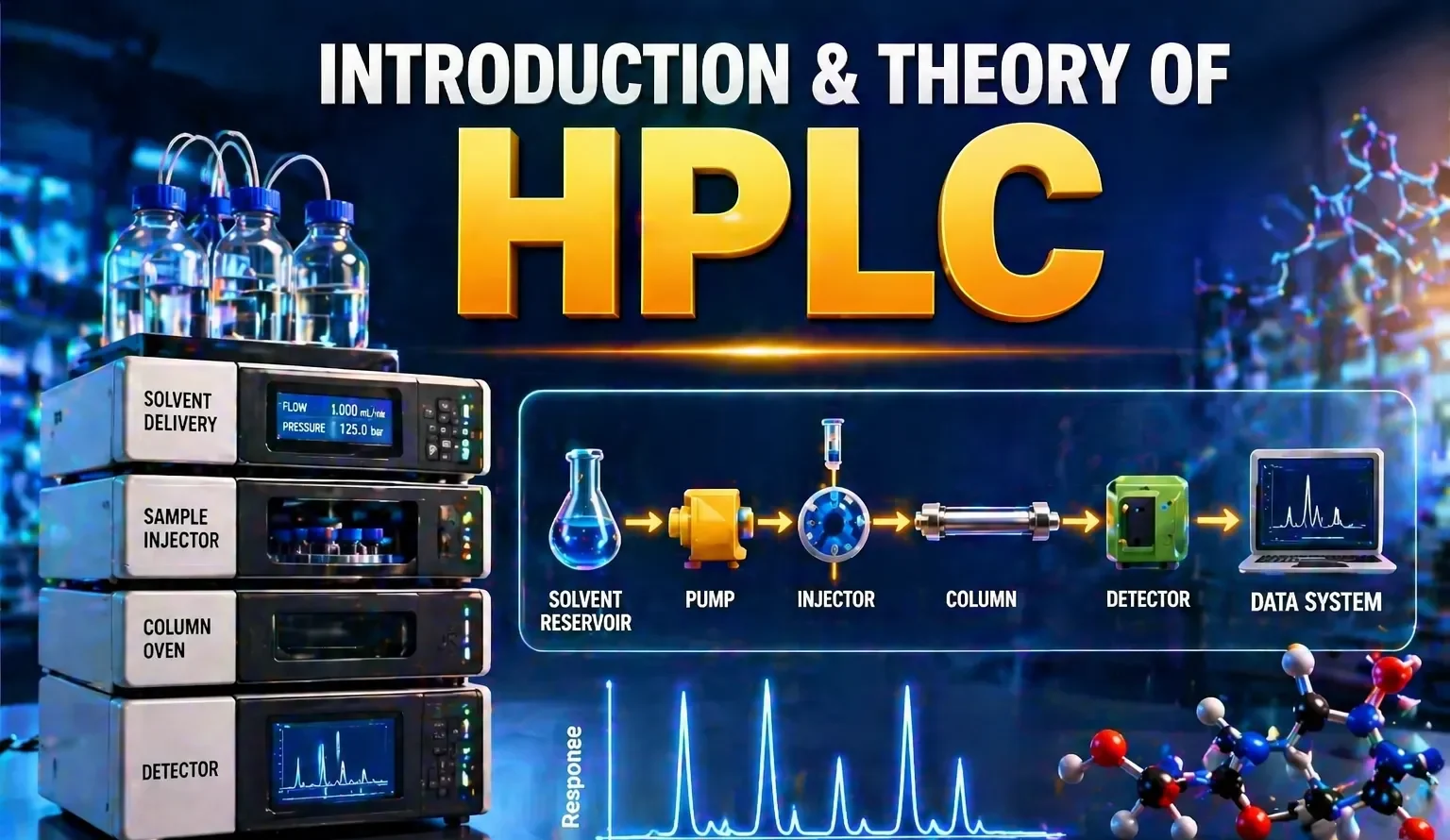
Introduction & Theory of HPLC
Introduction and Theory of HPLC explains separation of compounds using high pressure liquid mobile phase and stationary phase.
Introduction to HPLC
- Definition: An advanced liquid chromatography method for separating, identifying, and quantifying mixture components.
- Pharmaceutical Use: Widely adopted for its accuracy and reliability.
- Advancement: Unlike traditional liquid chromatography that uses gravity, HPLC employs high pressures to enhance separation and analysis precision.
Theory of HPLC
HPLC operates on the principle of partitioning analytes between a mobile phase and a stationary phase.
Advertisements
Key Concepts
-
Mobile Phase
- Role: Solvent(s) that transport analytes through the column under high pressure.
-
Stationary Phase
- Role: Packed column with coated particles that interact differently with each analyte, causing varied retention times.
-
Partitioning
- Mechanism: Analytes distribute between mobile and stationary phases based on their affinities.
-
Separation
- Outcome: Different retention times lead to the separation of compounds.
-
Detection
- Process: Eluted compounds pass through a detector, generating a chromatogram (signal vs. time/volume).
Types of Interactions in HPLC

-
Normal Phase HPLC (NP-HPLC)
- Stationary Phase: Polar (e.g., silica)
- Mobile Phase: Less polar (e.g., hexane)
- Separation Basis: Polarity
-
Reverse Phase HPLC (RP-HPLC)
- Stationary Phase: Non-polar or weakly polar
- Mobile Phase: Polar
- Usage: Most common in pharmaceuticals
-
Ion-Exchange HPLC
- Stationary Phase: Charged groups
- Separation Basis: Charge properties
-
Size Exclusion HPLC (SEC/GPC)
- Separation Basis: Molecular size
- Mechanism: Larger molecules elute first by exclusion from pores
Advertisements
Modes of Mobile Phase Delivery
-
Isocratic Elution
- Definition: Constant mobile phase composition throughout the run.
- Advantages: Simple setup, high reproducibility.
- Limitations: Less effective for complex mixtures, potential peak broadening.
-
Gradient Elution
- Definition: Mobile phase composition changes during the run.
- Advantages: Better separation for diverse compounds, sharper peaks, faster analyses.
- Limitations: More complex equipment, requires precise control for reproducibility.