
Ion Exchange Resins
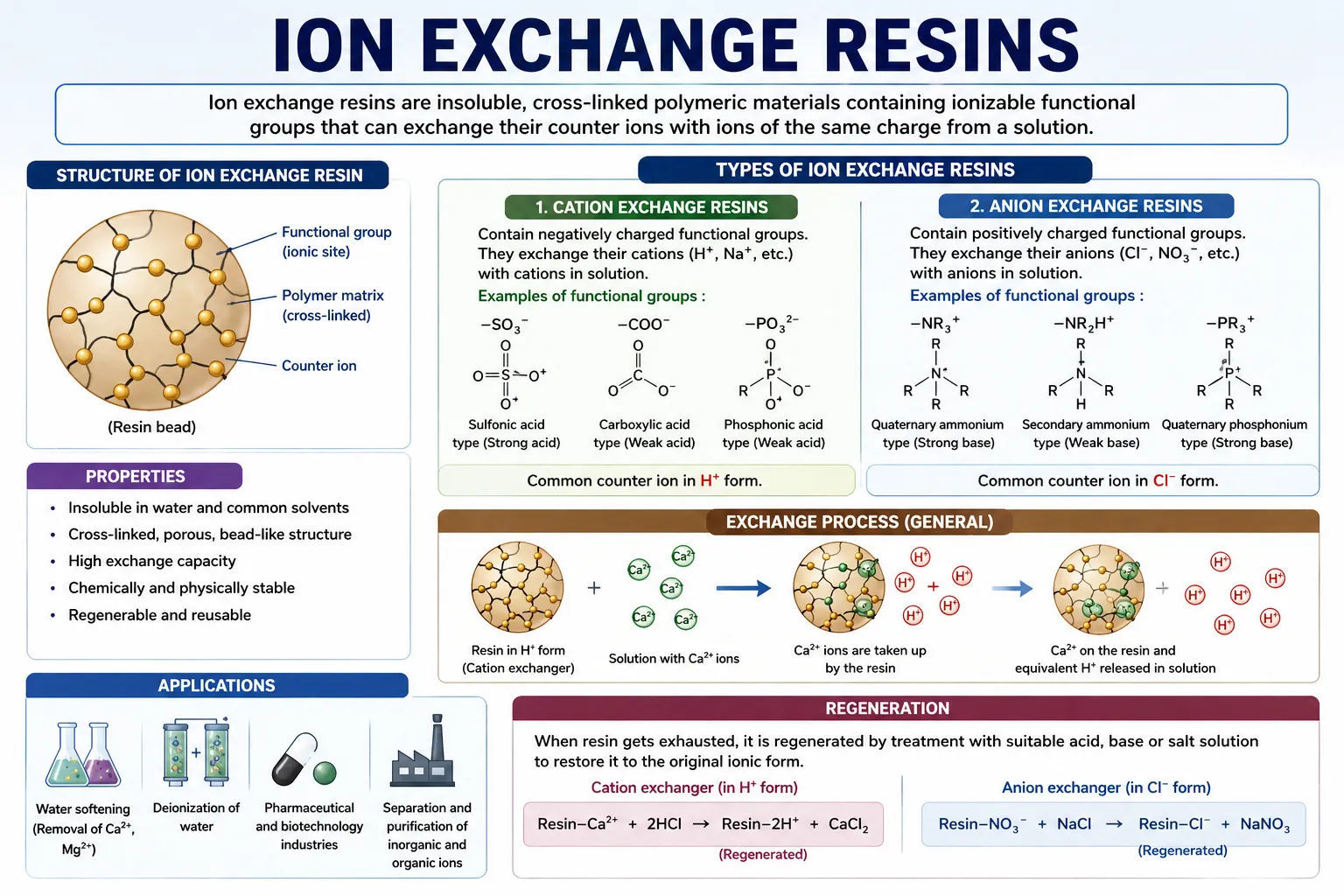
- Ion exchange resins are the core materials facilitating the separation of ions based on their charge.
- They are typically insoluble matrices in the form of small beads containing charged sites that attract and hold ions of opposite charge from a passing solution.
Structure of Ion Exchange Resins
- Polymer Base: Can be natural or synthetic, often cross-linked for mechanical stability and insolubility.
- Ionizable Groups: Covalently attached to the polymer, determining the resin’s charge properties.
Composition
- Base Polymers: Commonly synthesized from styrene-divinylbenzene or acrylic/methacrylic acid esters.
- Functional Groups:
- Cation Exchangers: Sulfonic (-SO₃⁻) or carboxyl (-COO⁻) groups.
- Anion Exchangers: -NR₃⁺ or Ammonium (-NR₃⁺) groups.
Advertisements
Classification of Ion Exchange Resins
-
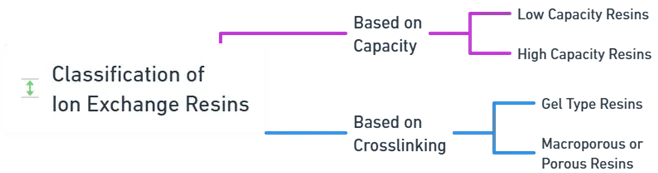
Based on Capacity:
- Low Capacity Resins:
- Have 1 milliequivalent (meq) or less of active sites per gram.
- High Capacity Resins:
- Have more than 1 meq of active sites per gram.
- Low Capacity Resins:
-
Based on Crosslinking:
- Gel Type Resins:
- Lower percentage of cross-linking (typically below 5%).
- Larger pore sizes and more flexibility.
- Macroporous or Porous Resins:
- Larger pores and greater mechanical stability.
- Suitable for industrial applications.
- Gel Type Resins:
Regeneration of Resins
- Usage and Saturation:
- Over time, the ion exchange sites become saturated with ions from the solution, reducing the resin’s effectiveness.
- Regeneration Process:
- The resin can be regenerated by washing it with a solution containing a high concentration of ions.
- These ions displace the adsorbed ions, restoring the resin to its original charged state.
Advertisements
Properties of Ion Exchange Resins
- Physical Form: Small beads (0.3 to 1.2 mm in diameter).
- Porosity: Determines accessibility of functional groups; higher porosity allows faster ion exchange.
- Stability: Must resist chemical degradation and maintain structural integrity under operating conditions.
- Regenerability: Ability to be regenerated for multiple uses.
- Selectivity: Preference for certain ions despite the potential to exchange any oppositely charged ion.
- Capacity: Total number of exchangeable ions, measured in milliequivalents per gram (meq/g).
- Kinetics: Rate of ion exchange; faster kinetics are desirable for efficiency.