
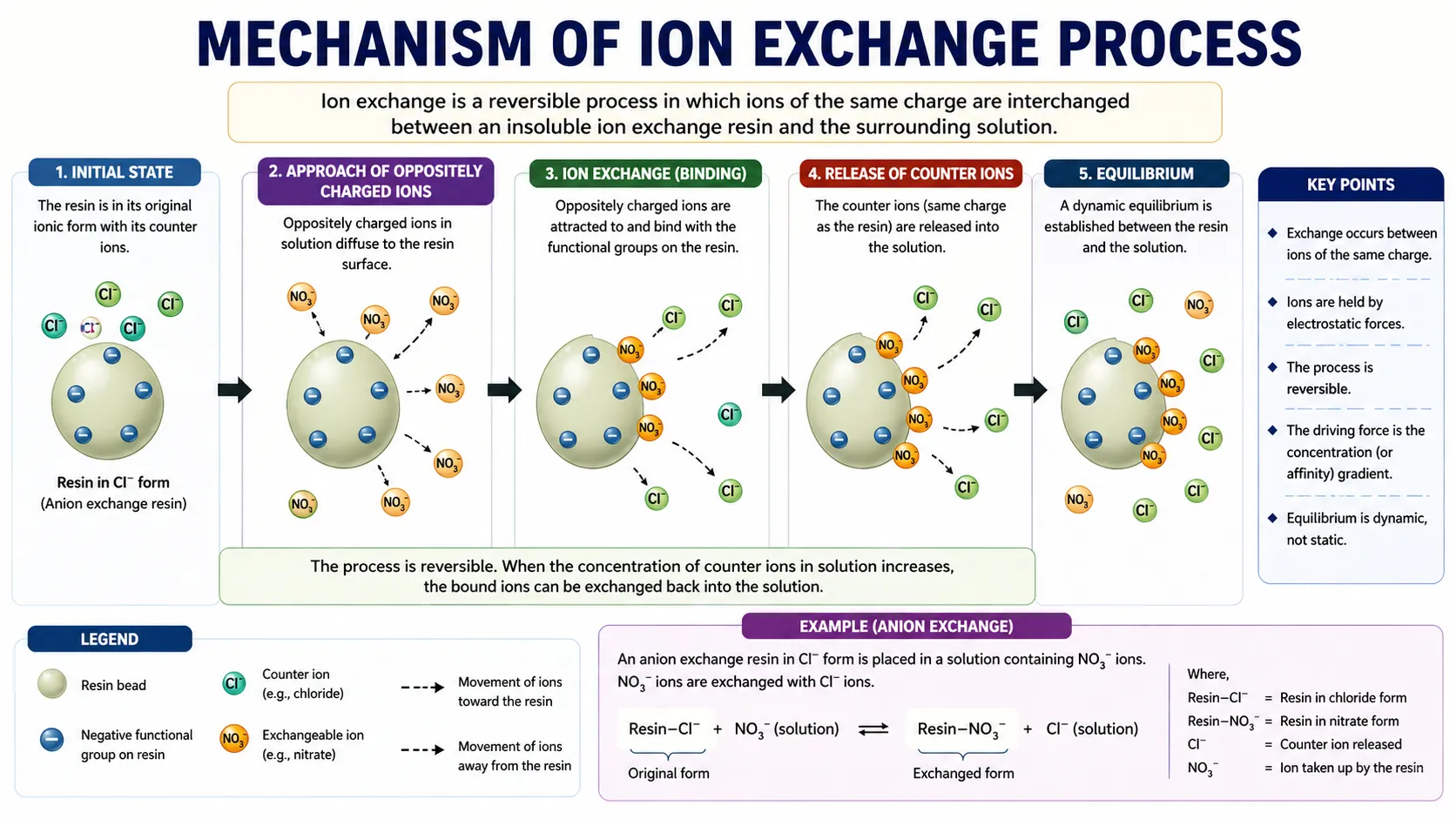
Mechanism of Ion Exchange Process explains reversible exchange of ions between solution and charged resin sites.
Mechanism of Ion Exchange Process
- Ion exchange chromatography operates through the reversible exchange of ions between the mobile phase and the stationary phase (resin).
Ion Exchange Mechanism
-
Equilibrium Process:
- Ions in the mobile phase displace counter-ions on the resin based on their affinities until equilibrium is achieved.
-
Selectivity:
- Differing affinities based on resin properties, ion types, and eluent conditions result in selective binding and separation.
-
Elution:
- Bound ions are released by altering the mobile phase’s ionic strength or pH, allowing competitive displacement.
Binding and Exchange Examples
- Cation Exchange Resin:
$\mathrm{SO_3^- H + Na^+ \rightarrow SO_3^- Na + H^+}$
- Anion Exchange Resin:
$\text{N(CH}_3)_3^{+}\text{Cl}^{-} + \text{Br}^{-} \rightarrow \text{N(CH}_3)_3^{+}\text{Br}^{-} + \text{Cl}^{-}$