
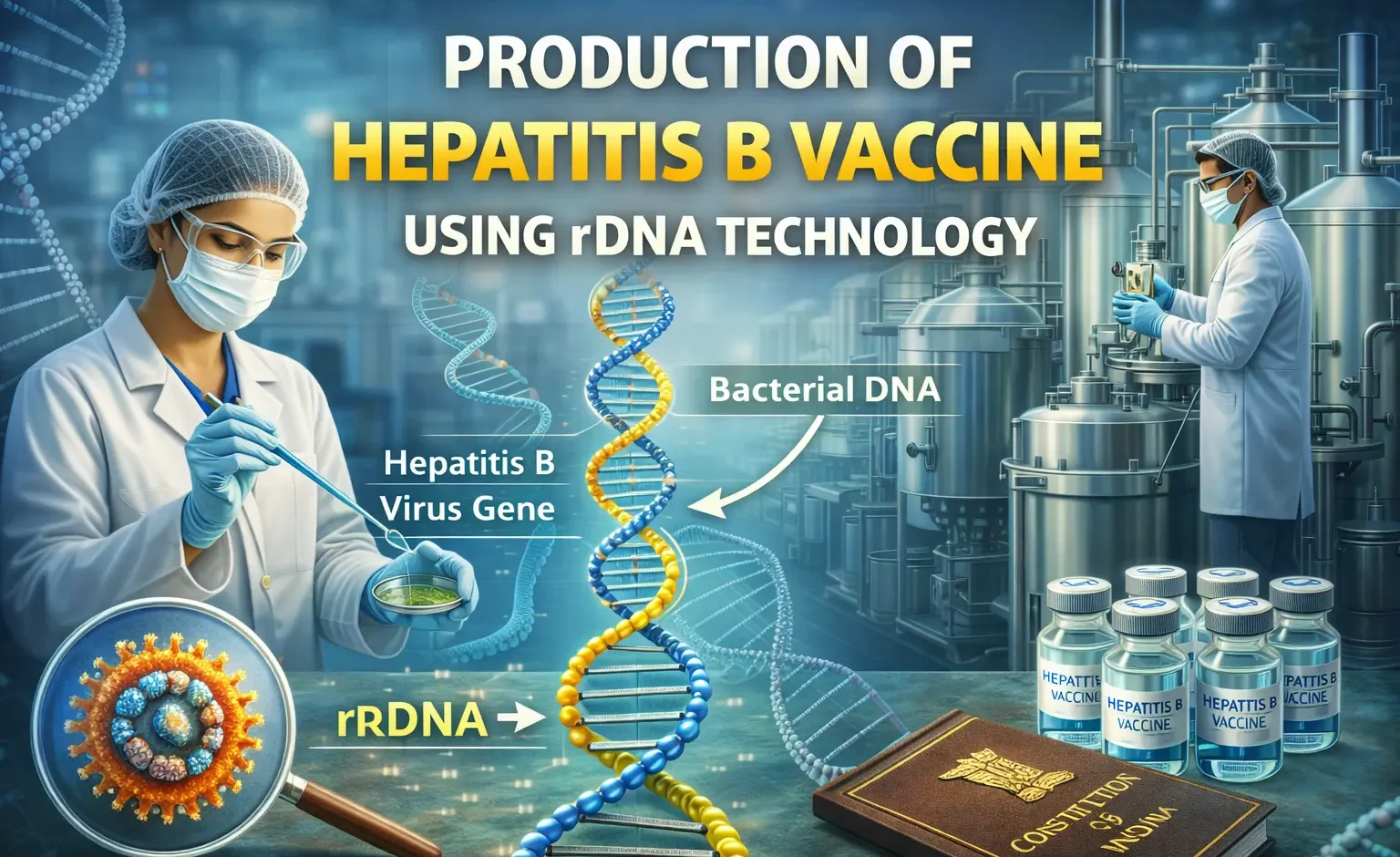
Production of Hepatitis B Vaccine Using rDNA Technology explains recombinant DNA steps expression systems and vaccine manufacturing process.
What is Hepatitis B?
- Hepatitis B is a viral infection caused by the Hepatitis B virus (HBV) that affects the liver, leading to cirrhosis and liver cancer.
- The best prevention method is vaccination.
Why Use Recombinant DNA Technology for Hepatitis B Vaccine?
- Earlier vaccines used inactivated viruses obtained from infected individuals, posing safety risks.
- Recombinant vaccines are safer because they contain only a genetically engineered surface protein of HBV, not the live virus.
Advertisements
Steps in Hepatitis B Vaccine Production Using rDNA Technology
- Gene Isolation – The gene for the HBV surface protein (HBsAg) is isolated.
- Cloning into a Vector – The gene is inserted into a bacterial or yeast expression vector.
- Host Cell Expression – The recombinant vector is introduced into E. coli or yeast to produce the surface protein.
- Purification – The protein is purified using chromatography to obtain highly pure HBsAg.
- Vaccine Preparation – The purified HBsAg is formulated into a vaccine.
How the Vaccine Works
- The vaccine contains HBsAg, which stimulates the immune system to produce antibodies against HBV.
- These antibodies protect against future hepatitis B infections.
Commercial Production Example
- The first recombinant Hepatitis B vaccine, Recombivax HB, was produced using yeast cells (Saccharomyces cerevisiae).
- The vaccine is highly effective (95% protection) and is used worldwide.
Advertisements