
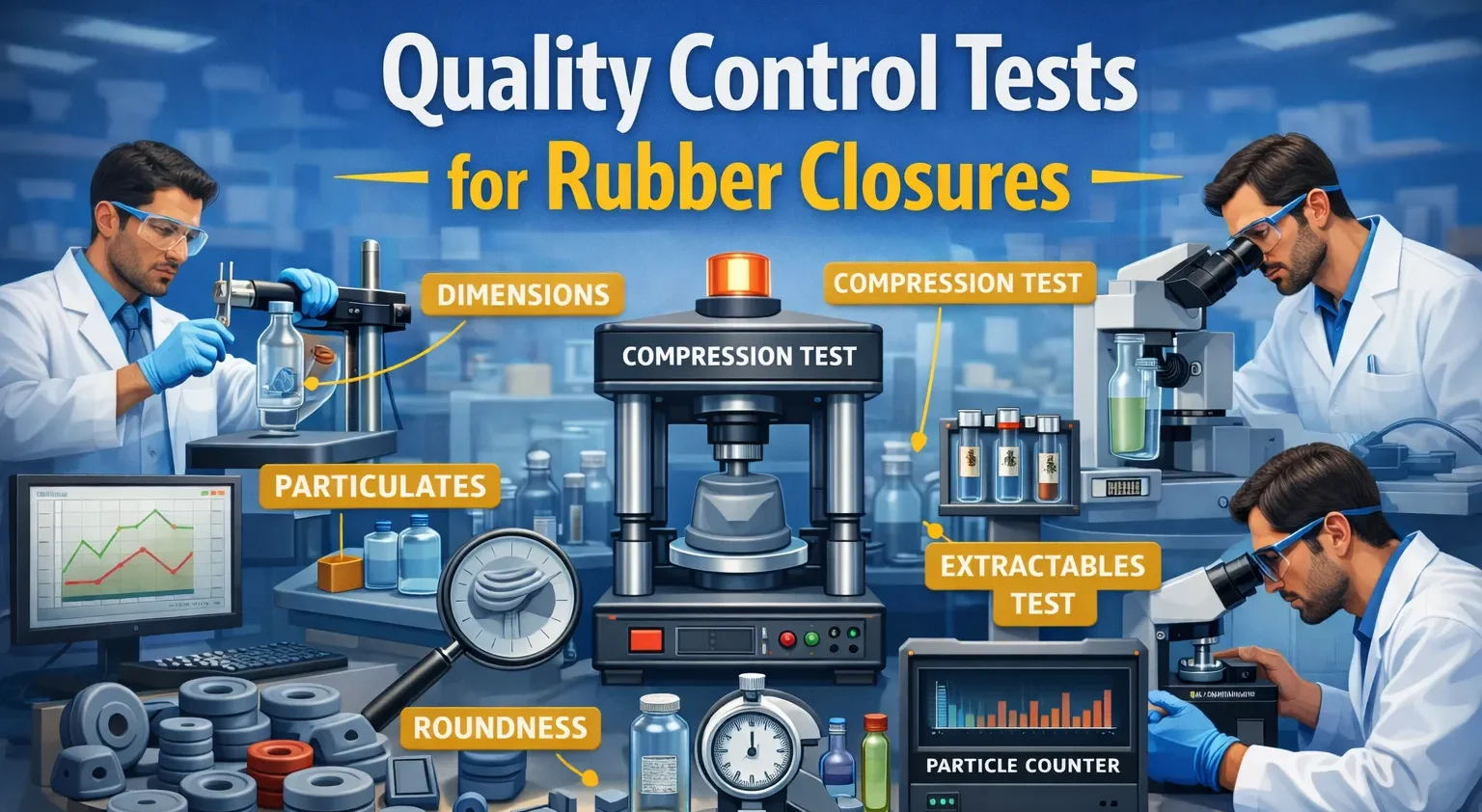
Quality Control Tests for Rubber Closures explain tests and standards ensuring safety and quality in pharmaceutical packaging.
- Rubber closures (stoppers) are critical for vials, bottles, and infusion bags, particularly for injectable and sterile products.
- They must maintain a tight seal, resist coring, and not introduce contaminants.
Types of Rubber Closures
- Natural Rubber: Has good elasticity but can have higher extractables.
- Butyl Rubber: A common choice, low permeability to gases and moisture.
- Silicone-Coated Rubber: Provides better lubricity and reduced interaction with the drug solution.
- Others: Nitrile, chlorobutyl, bromobutyl, etc., chosen based on product compatibility.
Advertisements
Key Tests for Rubber Closures
-
Physicochemical Tests
- Appearance: Checked for uniformity, color, and defects.
- pH of Aqueous Extract: Ensures that rubber does not alter the pH of liquid formulations.
- Extractable Substances Test: Determines if any harmful substances leach from the rubber into the drug.
-
Functional Tests
- Fragmentation Test: Assesses whether rubber sheds particles when punctured by a needle.
- Self-Sealing Test: Evaluates the closure’s ability to reseal after needle penetration.
- Penetrability Test: Ensures the stopper is easily punctured by a syringe.
-
Chemical and Biological Tests
- Heavy Metals Test: Ensures no toxic metals are present.
- Sterility Test: Ensures that closures do not introduce microbial contamination.
- Bacterial Endotoxin Test (LAL Test): Checks for the presence of pyrogens, which can cause fever in patients.