
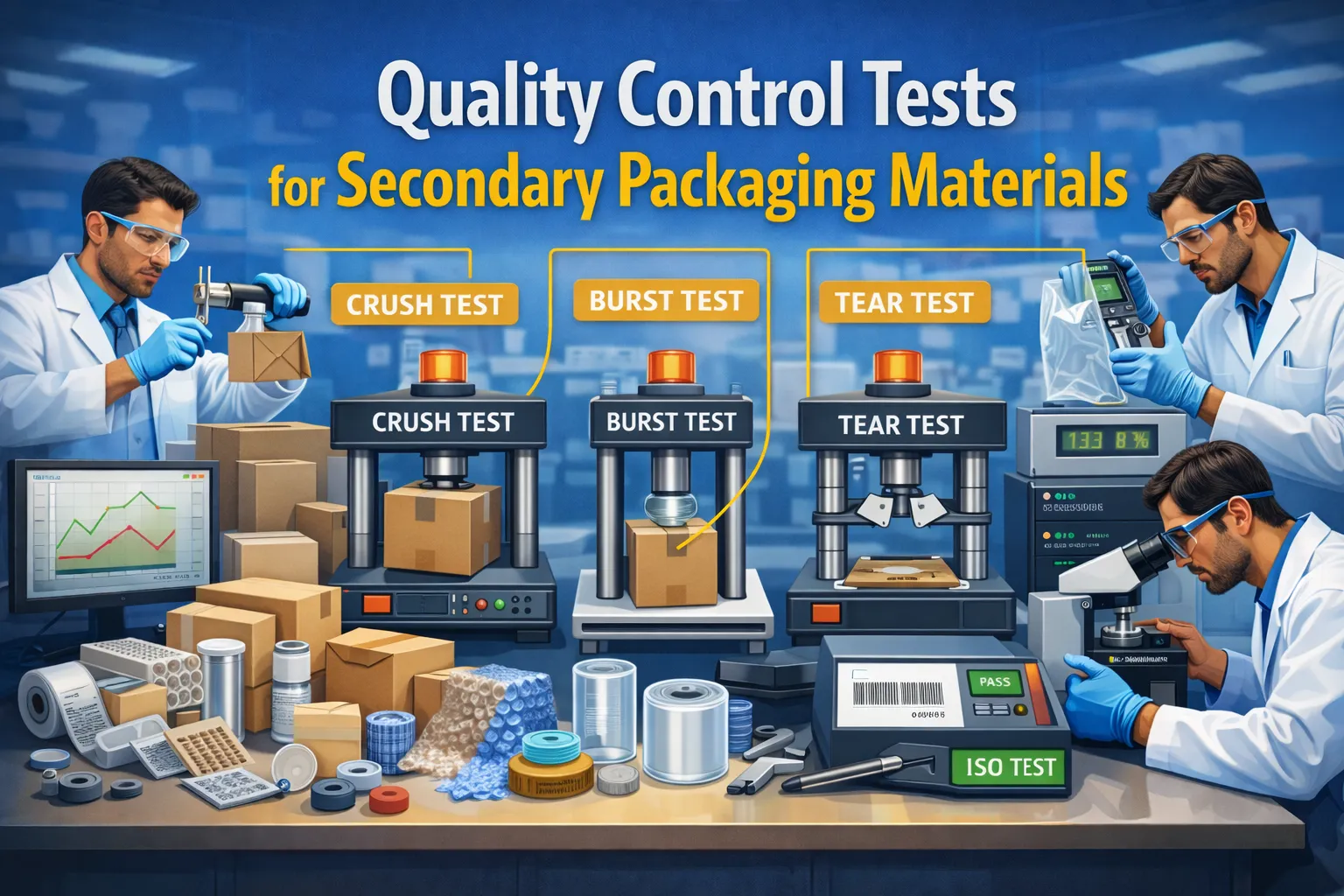
Quality Control Tests for Secondary Packaging Materials explain tests and standards ensuring protection and quality in pharmaceuticals.
Quality Control Tests for Secondary Packaging Materials
- Secondary packaging includes components such as boxes, cartons, labels, and leaflets.
- While these materials do not directly contact the drug product, they play a crucial role in ensuring information clarity, protection, and proper product identification.
Cartons and Boxes
-
Dimension and Fit Tests
- Ensures proper sizing to prevent damage to the primary container.
- Verifies that packaging allows for safe shipping and storage.
-
Material Strength (Bursting, Compression, Puncture Resistance)
- Evaluates the ability of cartons to withstand transportation and storage conditions.
- Tests include:
- Bursting strength test – Determines resistance to internal pressure.
- Compression test – Assesses structural integrity under load.
- Puncture resistance test – Ensures protection against sharp objects.
-
Print Quality and Legibility
- Ensures clear printing of instructions, batch details, and labeling for patient safety and regulatory compliance.
- Checks include:
- Smudging resistance
- Color uniformity
- Barcode/QR code scan-ability
-
Ink Toxicity and Migration
- Ensures that printing inks used on secondary packaging do not migrate into the product or cause contamination.
- Particularly important when secondary packaging is stored close to the primary container.
Advertisements
Labels
-
Adhesion / Peel Strength
- Ensures the label remains firmly attached throughout the product’s shelf life.
- Tested under different storage conditions, including refrigeration and humidity exposure.
-
Legibility and Durability
- Verifies that label text remains clear and intact under normal handling, moisture, or light exposure.
- Special tests may be required for:
- Cryogenic labels (for cold-chain applications)
- UV-resistant labels (for products exposed to light)
-
Regulatory Requirements for Labeling
- Labels must comply with regulatory guidelines, including:
- Language and font size requirements
- Inclusion of mandatory statements
- Proper display of product name, strength, batch details, and expiration date
- Labels must comply with regulatory guidelines, including: