
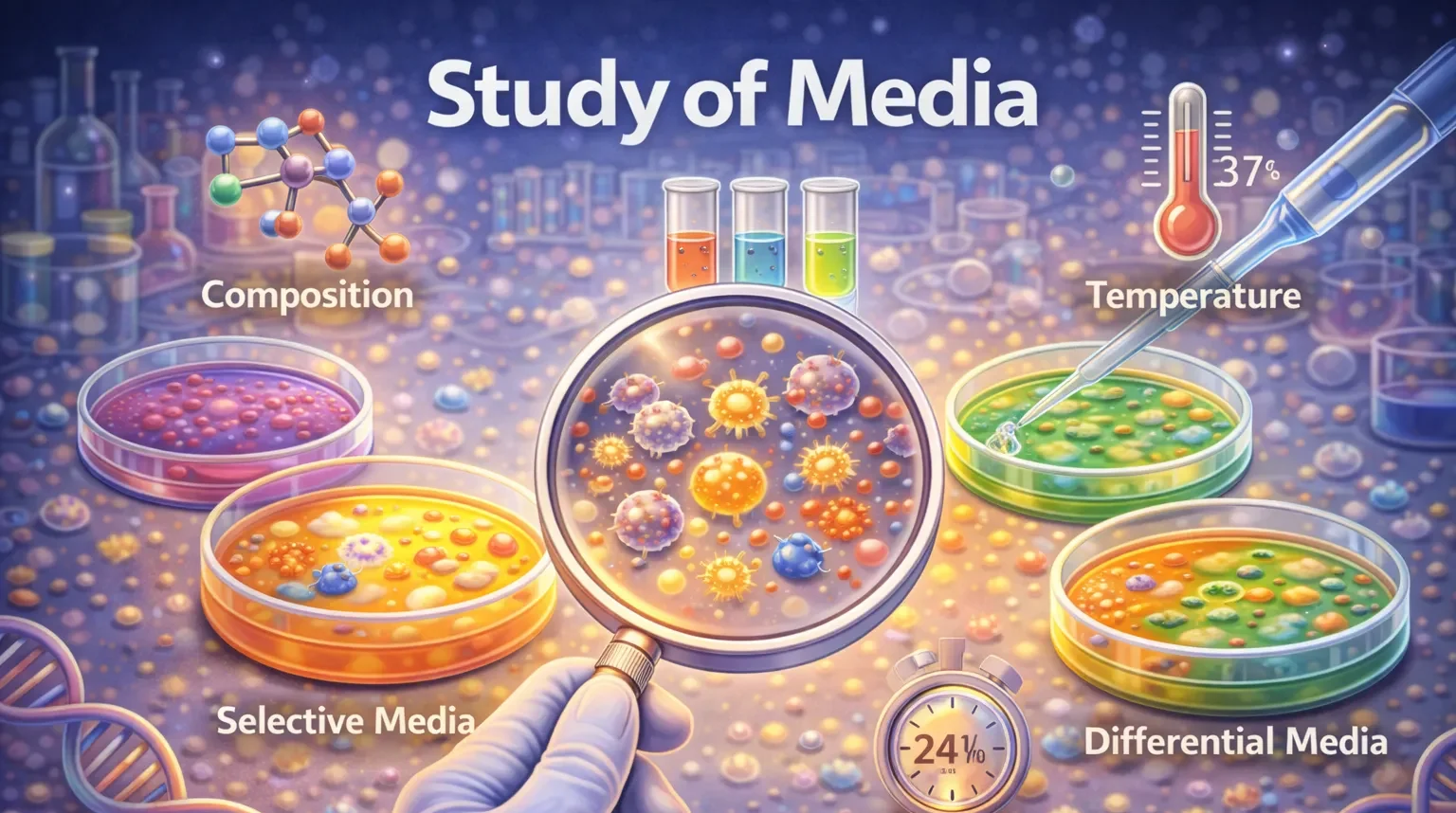
Study of media explains types composition preparation and importance of culture media in microbiology and fermentation.
Study of media
- Fermentation media provide essential nutrients for microbial growth and product formation.
- It significantly impacts productivity and efficiency.
Types of Media:

They are classified as:
Advertisements
-
Synthetic or Defined Media
- Contains chemically defined components.
- Used for research purposes to study specific microbial needs.
-
Complex Media
- Contains undefined components such as yeast extract, peptone, and malt extract.
- Commonly used in industrial fermentation.
-
Selective Media
- Encourages the growth of specific microorganisms while inhibiting others.
- Example: Media for lactic acid bacteria in dairy fermentation.
-
Production Media
- Optimized for large-scale product formation.
- Contains specific nutrients to enhance yield.
-
Enriched Media
- Supplemented with additional nutrients to support fastidious organisms.
Components of Media:
- Carbon source (glucose, sucrose, lactose, molasses).
- Nitrogen source (ammonia, nitrates, yeast extracts, peptone).
- Minerals and Vitamins (magnesium, phosphate, iron).
- Growth factors (vitamins, amino acids).