
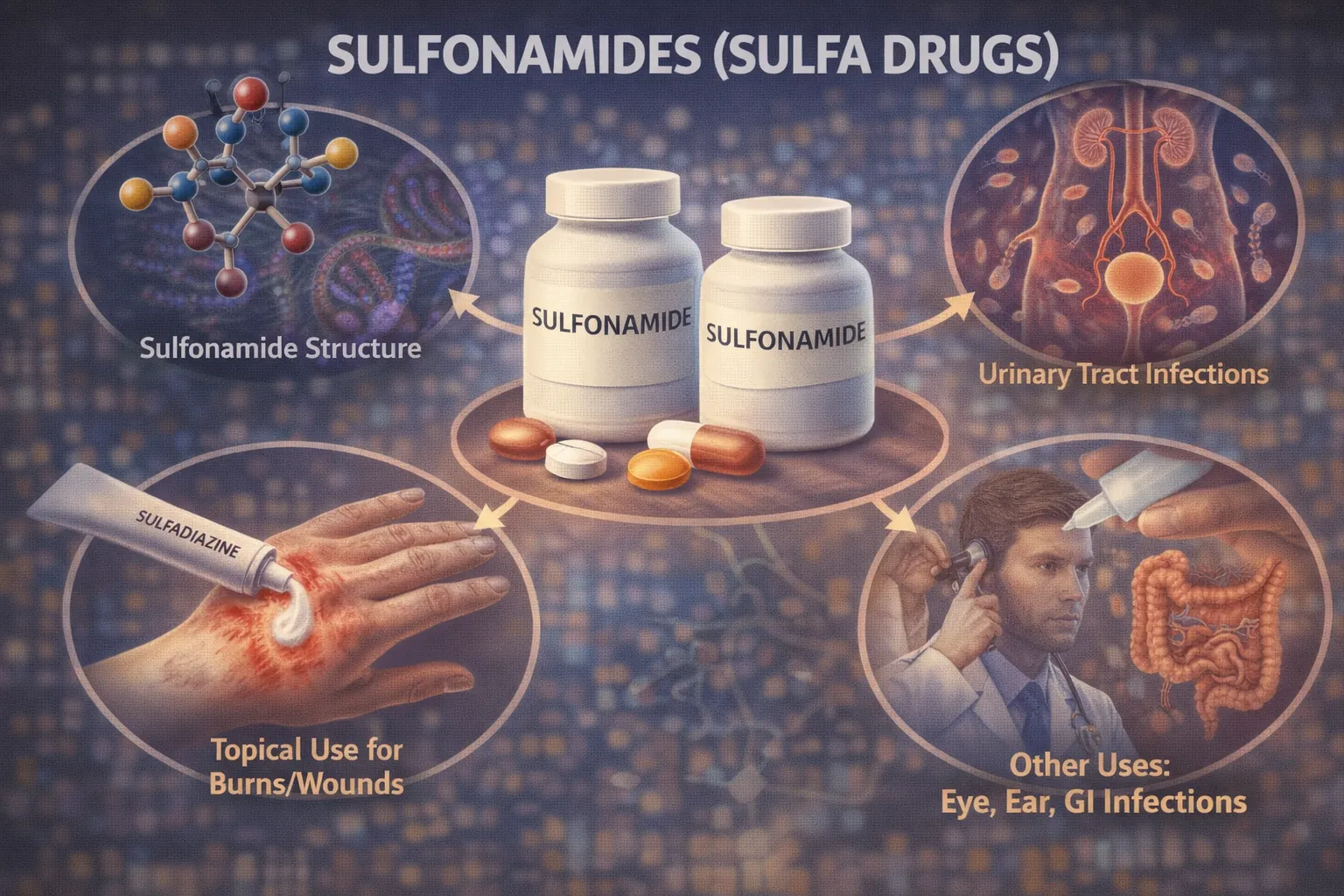
Definition of Sulfonamides (Sulfa Drugs)
- Sulfonamides are synthetic antimicrobial agents used to treat bacterial infections.
- Available in oral and topical forms (tablets, creams, solutions).
Mechanism of Action
- They inhibit dihydropteroate synthase, an enzyme involved in folic acid synthesis, essential for bacterial DNA/RNA production — resulting in a bacteriostatic effect.
Classification of Sulfonamides

Advertisements
- Sulfonamides, or sulfa drugs, are classified based on their half-life and route of use:
Advertisements
-
Short-acting Sulfonamides
- Short half-life; require frequent dosing.
- Examples: Sulfisoxazole, Sulfamethoxazole, Sulfadiazine
-
Intermediate-acting Sulfonamides
- Moderate half-life; less frequent dosing.
- Examples: Sulfadimethoxine, Sulfadoxine
-
Long-acting Sulfonamides
- Long half-life; given once daily or less.
- Examples: Sulfamethazine, Sulfamethoxypyridazine
-
Topical Sulfonamides
- Applied to skin or mucosa for localized infections (e.g., burns, wounds, eyes).
- Examples: Silver sulfadiazine, Mafenide acetate
-
Combination Sulfonamides
- Combined with other antimicrobials to enhance efficacy.
- Examples: Sulfamethoxazole + Trimethoprim (Co-trimoxazole), Sulfadiazine + Pyrimethamine
Uses of Sulfonamides (Sulfa Drugs)
- UTIs
- Respiratory infections
- Skin/soft tissue infections
- Toxoplasmosis
- Rheumatic fever prophylaxis
Advertisements
Adverse Effects
- Hypersensitivity reactions (e.g., rash, Stevens-Johnson syndrome)
- GI issues (nausea, vomiting)
- Blood disorders (anemia, leukopenia)
- CNS effects (dizziness, headache)
- Photosensitivity
- Renal/liver toxicity