
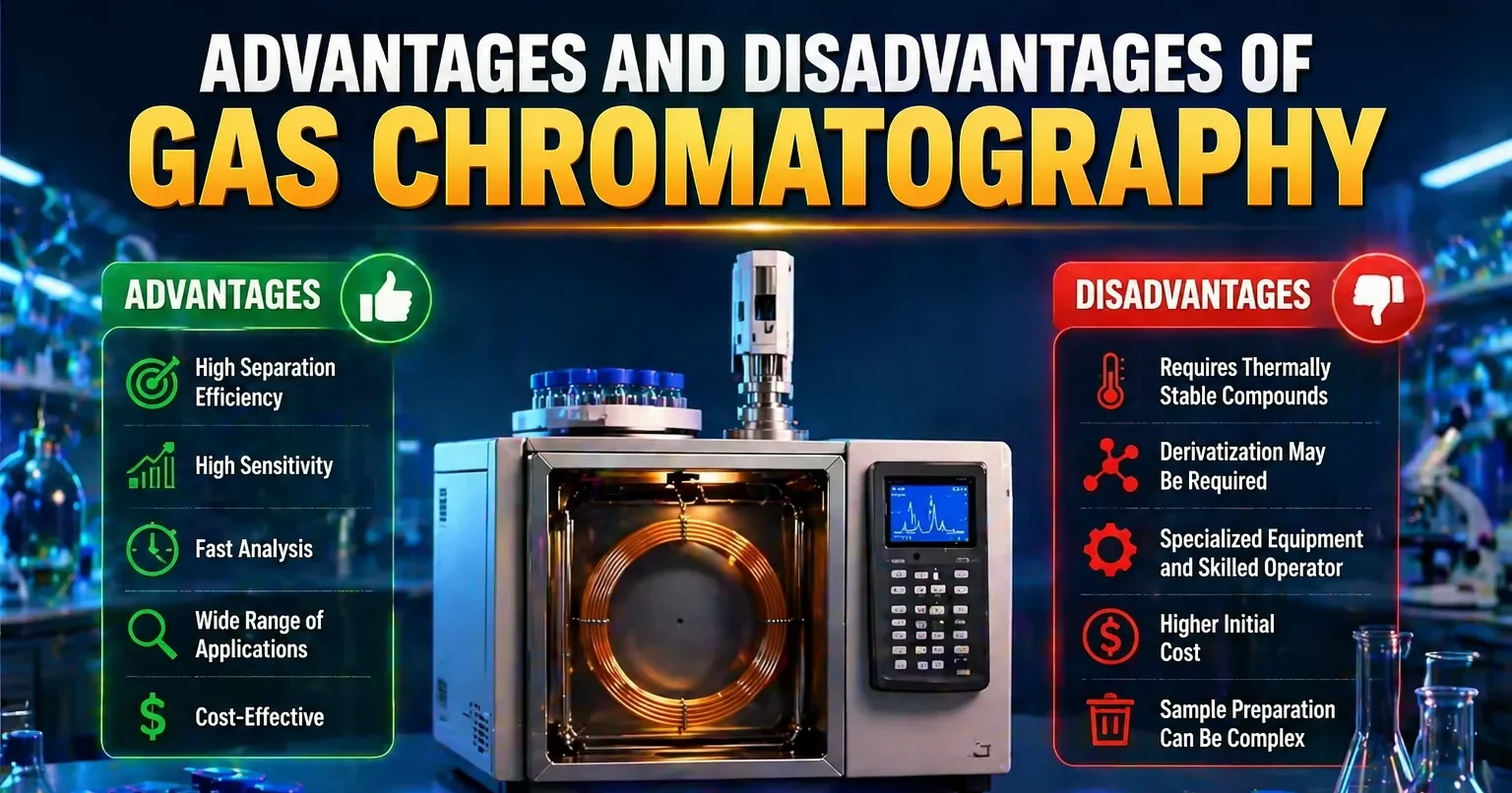
Advantages and Disadvantages of Gas Chromatography
Advantages and Disadvantages of Gas Chromatography highlight its high resolution, speed, and limitations with non-volatile compounds.
Advantages
- High Resolution: Effective separation of complex mixtures, including trace components.
- Speed: Rapid analyses, often completed within minutes.
- Precision: Highly reproducible and suitable for quantitative analyses.
- Flexibility: Variety of detectors available for selective or general detection.
- Small Sample Size: Requires only microgram to milligram quantities.
- Automation: Auto-samplers enable high-throughput and reduce manual handling.
- Coupling with Other Instruments: Integration with mass spectrometry (GC-MS) for comprehensive qualitative and quantitative analysis.
Disadvantages
- Volatile Samples Required: Non-volatile or thermally unstable compounds need derivatization.
- Degradation of Stationary Phase: Exposure to dirty or reactive samples can degrade the stationary phase.
- Non-Recoverable Sample: Analyzed samples cannot be recovered post-injection.
- Safety Concerns: High temperatures and flammable gases necessitate stringent safety measures.
- Column Bleed: Stationary phase degradation over time can cause baseline drift.
- Maintenance: Regular upkeep of columns and detectors is essential for optimal performance.
Click Here to Watch the Best Pharma Videos
Advertisements