

Temperature Programming in Gas Chromatography varies column temperature to improve separation of compounds with different volatilities.
- Temperature programming involves changing the column temperature during analysis to improve separation and reduce run time, especially for compounds with a wide range of boiling points.
Benefits
- Improved Resolution: Separates compounds that co-elute at constant temperatures.
- Reduced Analysis Time: High boiling compounds elute faster with increasing temperature.
- Protects Stationary Phase: Lower starting temperatures prevent thermal degradation.
Procedure of Temperature Programming in Gas Chromatography
Advertisements
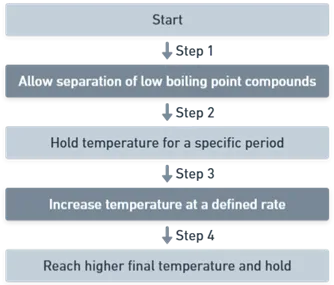
- Step 1: Start at a low temperature to allow separation of low boiling point compounds.
- Step 2: Hold the temperature for a specific period (e.g., 2 minutes).
- Step 3: Gradually increase the temperature at a defined rate (e.g., 10°C/min).
- Step 4: Reach a higher final temperature and hold for another period to ensure all high boiling point compounds elute.
Example
- Start: 40°C, hold for 2 minutes.
- Ramp: Increase at 10°C/min to 280°C.
- Hold: Maintain 280°C for 5 minutes for heavier compounds.