
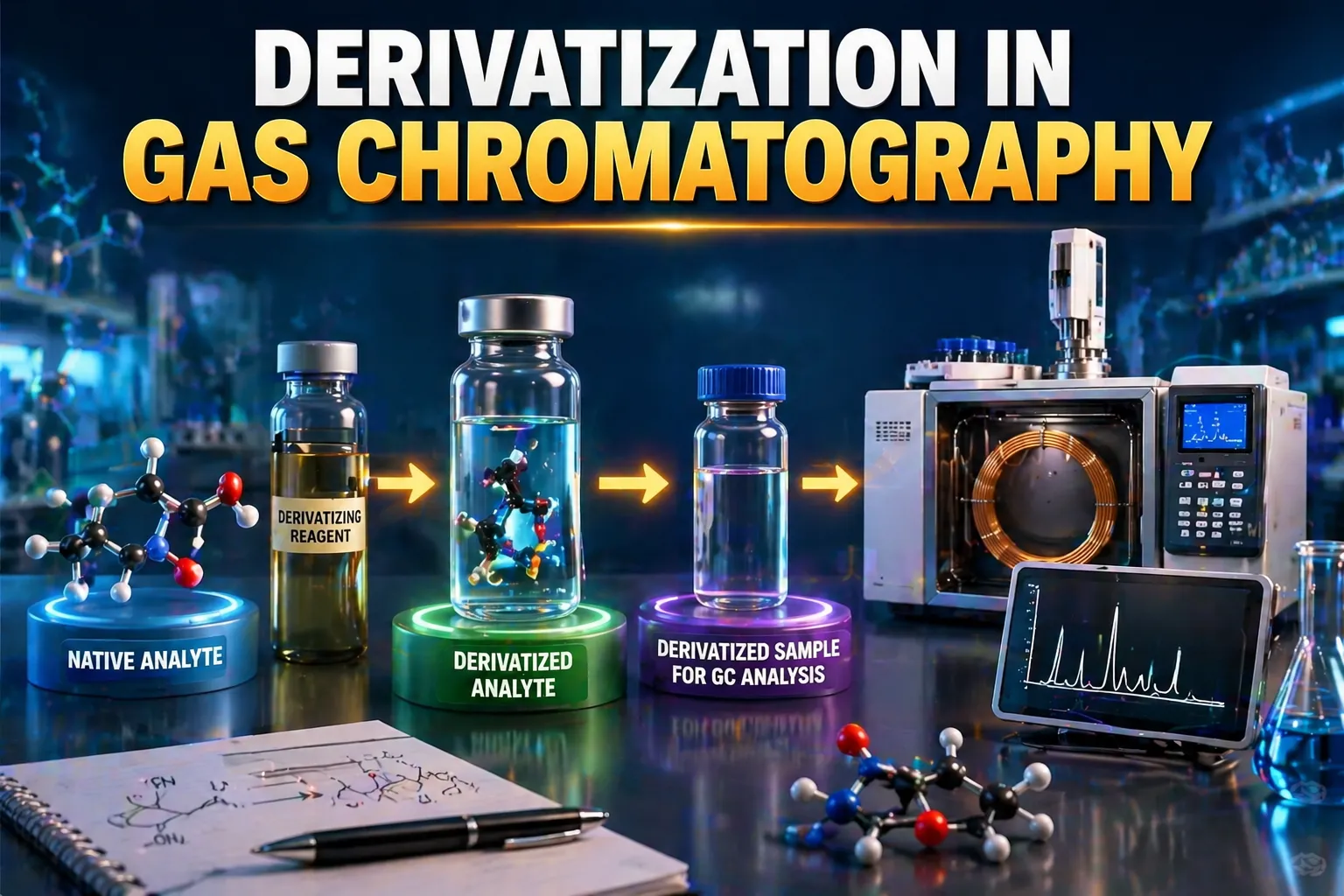
Derivatization in Gas Chromatography
Derivatization in Gas Chromatography modifies compounds to increase volatility or detectability for accurate analysis.
What is Derivatization?
- Chemical modification of a compound to form a derivative more suitable for GC analysis (improved volatility, thermal stability, and detectability).
Why is Derivatization Needed?
-
Enhance Volatility:
- Converts non-volatile or high boiling point compounds into more volatile derivatives.
-
Improve Thermal Stability:
- Prevents decomposition of compounds that are unstable at GC analysis temperatures.
-
Improve Detectability:
- Enhances signal strength or introduces functional groups that respond better to detectors.
-
Resolution and Selectivity:
- Modifies compound polarity to improve separation and resolve co-eluting compounds.
Advertisements
Types of Derivatization

-
Silylation:
- Introduces trimethylsilyl groups.
- Common for alcohols, phenols, carboxylic acids, and amines.
- Reagents: BSTFA, TMSCl.
-
Acylation:
- Introduces acyl groups.
- Common for alcohols and amines.
- Reagents: Acetic anhydride, Trifluoroacetic anhydride.
-
Esterification:
- Converts carboxylic acids into esters.
- Enhances volatility.
- Reagents: Diazomethane (methyl esters), Boron trifluoride-methanol.
-
Alkylation:
- Introduces alkyl groups.
- Example: Methylation of phenols using diazomethane.
Considerations
- Efficiency and Reproducibility: Complete and consistent conversion of analytes.
- Reagent and Condition Selection: Avoids side reactions and multiple derivative formations.
- Derivative Stability: Ensures derivatives remain stable between derivatization and analysis.
Advertisements
Ideal Characteristics of Derivatives
- High Volatility: Ensures effective GC analysis.
- Thermal Stability: Prevents decomposition at GC temperatures.
- Reproducibility: Consistent and complete derivatization reactions.
- Distinctiveness: Unique and recognizable peaks in chromatograms.
- High Sensitivity: Enhanced detectability compared to original compounds.
Disadvantages of Derivatization
- Extra Step: Adds time and complexity to sample preparation.
- Incomplete Reactions: May result in mixtures of original compounds and derivatives, complicating analysis.
- Side Reactions: Potential formation of multiple derivatives or unwanted by-products.
- Stability Issues: Some derivatives may degrade over time, affecting accuracy.
- Cost and Safety: Derivatizing agents can be expensive, toxic, or hazardous.
Click Here to Watch the Best Pharma Videos
Advertisements