
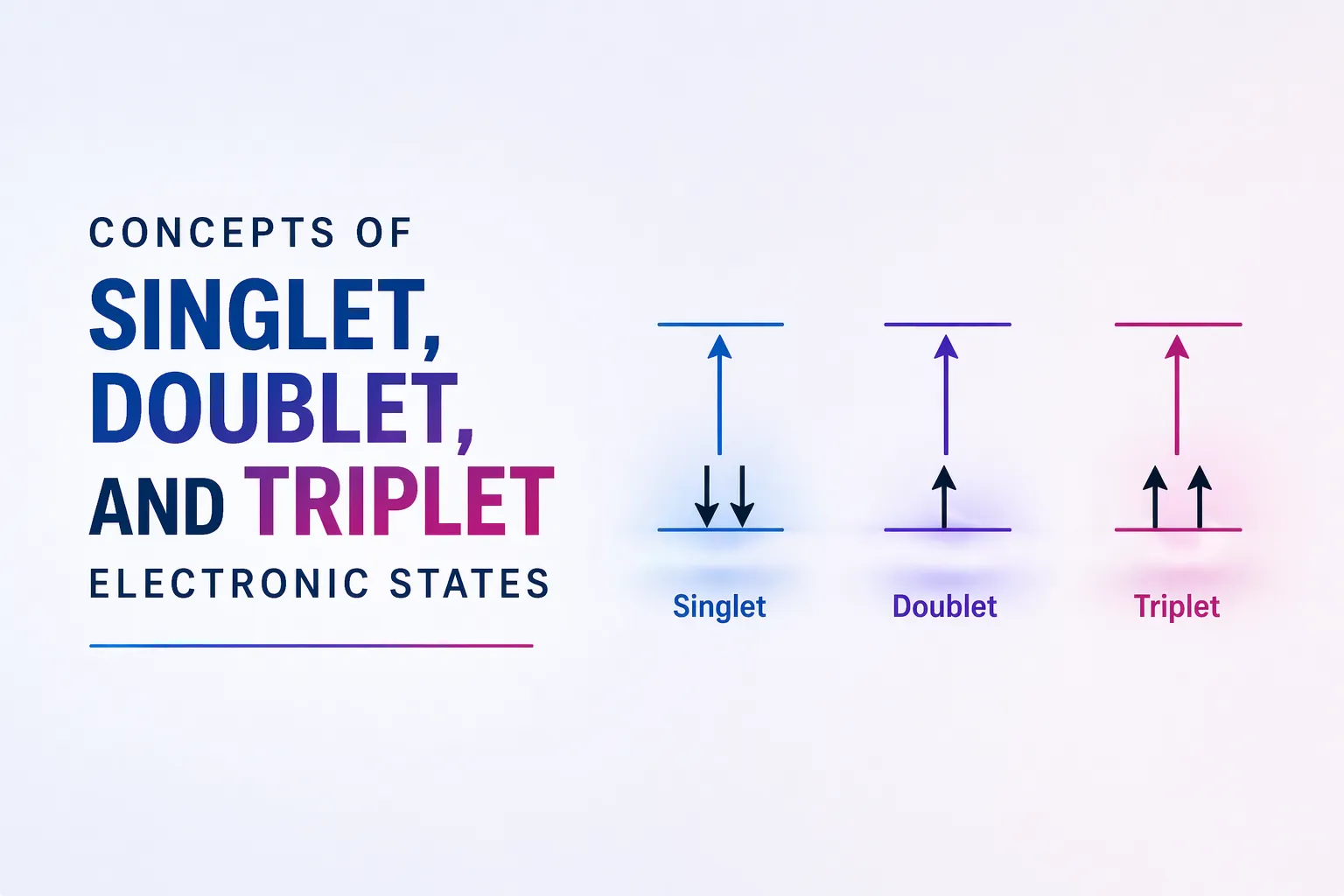
Concepts of Singlet, Doublet, and Triplet Electronic States explain electron spin states important in spectroscopy and photochemistry.
Concepts of Singlet, Doublet, and Triplet Electronic States
- These states describe the spin configurations of electrons in atoms or molecules and are fundamental in spectroscopy and photochemistry.
Key Concepts:
-
Electron Spin:
- Electrons have an intrinsic angular momentum, spin, with values of +½ (spin-up) or -½ (spin-down).
-
Pauli Exclusion Principle:
- No two electrons in the same orbital can have identical quantum numbers; thus, electrons in the same orbital must have opposite spins.
-
Multiplicity:
- Defined as 2S+12S + 12S+1, where SSS is the total spin quantum number (sum of unpaired electron spins).
- Indicates the number of possible spin states for a given configuration.
Advertisements
Singlet, Doublet, and Triplet States:
-
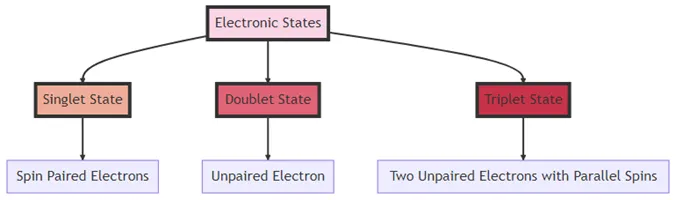
Singlet State:
- Electron Configuration: No unpaired electrons; all are spin-paired.
- Total Spin (SSS): 0
- Multiplicity: 2(0)+1=12(0) + 1 = 12(0)+1=1
- Example: Ground state of most closed-shell molecules (1X^1X1X, e.g., 1S^1S1S).
-
Doublet State:
- Electron Configuration: One unpaired electron (common in radicals).
- Total Spin (SSS): ½½½
- Multiplicity: 2(½)+1=22(½) + 1 = 22(½)+1=2
- Example: Radical species (2X^2X2X).
-
Triplet State:
- Electron Configuration: Two unpaired electrons with parallel spins.
- Total Spin (SSS): 1
- Multiplicity: 2(1)+1=32(1) + 1 = 32(1)+1=3
- Example: Excited states of many molecules (3X^3X3X, e.g., 3P^3P3P).
Jablonski Diagram
A Jablonski diagram illustrates the electronic states of a molecule and the transitions between them:
Advertisements
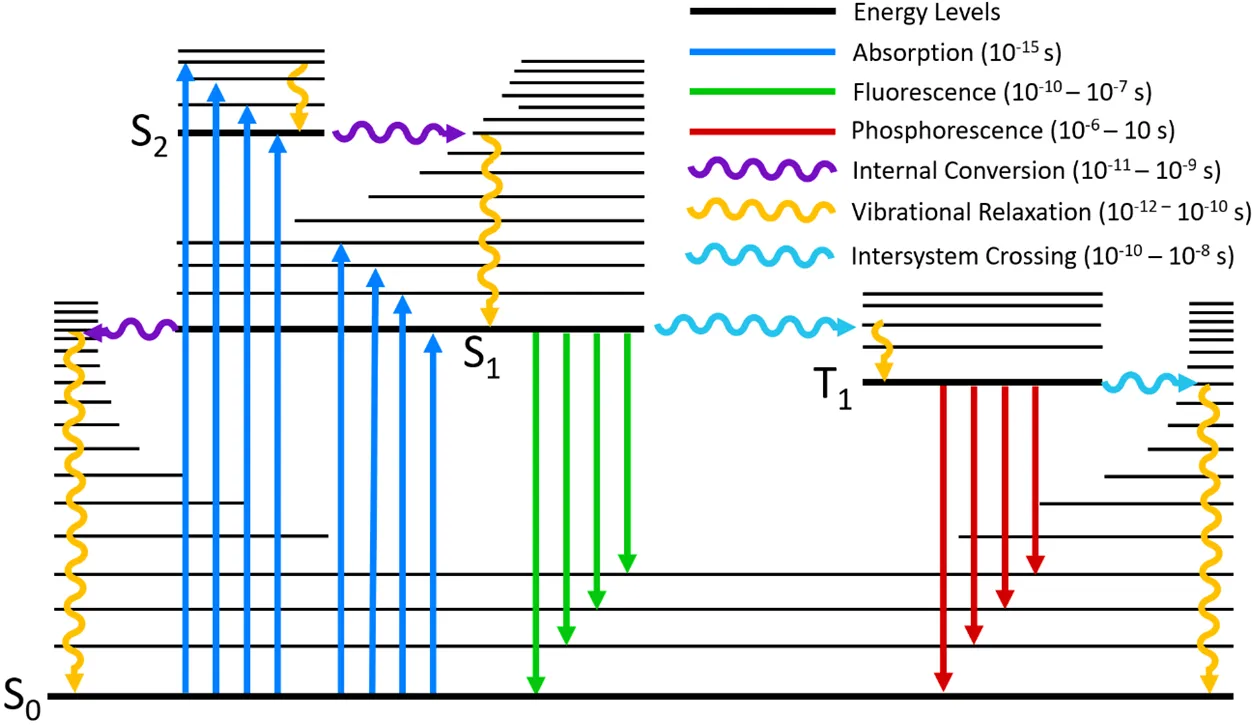
- Vertical Transitions: Represent absorption of photons leading to excitation.
- Horizontal Transitions: Indicate non-radiative processes like internal conversion and intersystem crossing.
- Downward Transitions: Depict emission processes such as fluorescence and phosphorescence.
Click Here to Watch the Best Pharma Videos
Advertisements