

Internal and external conversions
Internal and external conversions explain energy transfer processes that occur after molecular excitation in spectroscopy.
Internal Conversion (IC):
- Definition: A non-radiative process where an excited molecule transitions between electronic states of the same spin multiplicity without emitting a photon.
- Mechanism: Energy is dissipated as vibrational energy to the surrounding environment (solvent or lattice).
- Effect on Fluorimetry: Reduces fluorescence intensity by providing a pathway for the excited state to relax without emission.
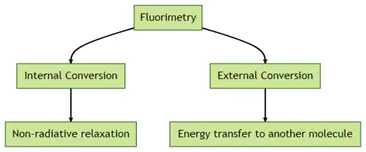
External Conversion (EC):
- Definition: A non-radiative process involving the transfer of energy from an excited molecule to another molecule (quencher) in the vicinity.
- Mechanism: Energy is transferred to another molecule, which dissipates it as heat or undergoes its own transitions.
- Effect on Fluorimetry: Also reduces fluorescence intensity by competing with the radiative emission process.
Advertisements
Comparison:
- Internal Conversion: Involves transitions within the same molecule.
- External Conversion: Involves energy transfer between different molecules.
Role in Fluorimetry:
- Both internal and external conversions are pathways that decrease the quantum yield of fluorescence, affecting the sensitivity and accuracy of fluorimetric measurements.