
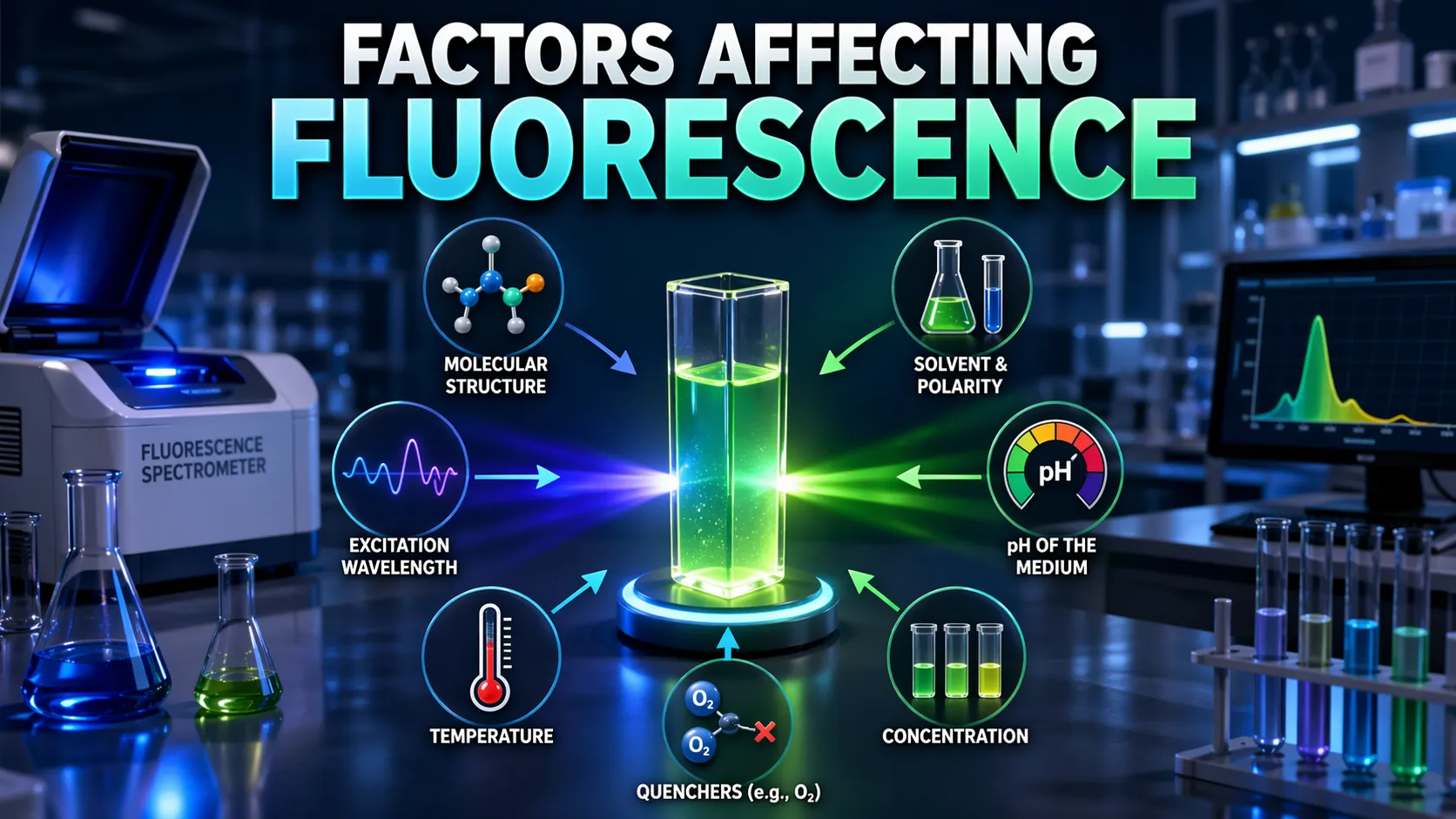
Factors affecting fluorescence
Factors affecting fluorescence include structure, pH, temperature, solvent, and concentration influencing light emission intensity.
-
Quantum Yield (Φₓ)
- Definition: The ratio of the number of photons emitted to the number of photons absorbed.
- Formula:
- $\Phi_x = \frac{\text{Number of photons emitted}}{\text{Number of photons absorbed}}$
- Influence: Higher quantum yields indicate more efficient fluorescence.
-
Molecular Structure
- Conjugation: Extended π-electron systems enhance fluorescence.
- Rigidity: Rigid structures reduce non-radiative decay pathways.
- Functional Groups: Electron-donating groups can increase fluorescence intensity.
-
Solvent Effects
- Polarity: Polar solvents can stabilize excited states differently than ground states, affecting energy gaps.
- Viscosity: Higher viscosity reduces molecular motions, potentially increasing fluorescence.
- Hydrogen Bonding: Can alter electronic energy levels and fluorescence properties.
-
Temperature
- Effect: Increased temperature enhances molecular collisions, promoting non-radiative decay and decreasing fluorescence.
-
pH
- Ionization States: Protonation or deprotonation can change electronic structures, influencing fluorescence.
- Applications: Useful in studying pH-dependent fluorescence of compounds.
-
Concentration
- Self-Quenching: At high concentrations, interactions between fluorophore molecules can lead to quenching.
- Inner Filter Effect: Reabsorption of emitted light by other molecules in the sample reduces observed fluorescence.
-
Presence of Quenchers
- Oxygen: A common quencher due to its paramagnetic nature.
- Halide Ions: Heavy atoms can enhance intersystem crossing, reducing fluorescence.
Click Here to Watch the Best Pharma Videos
Advertisements