
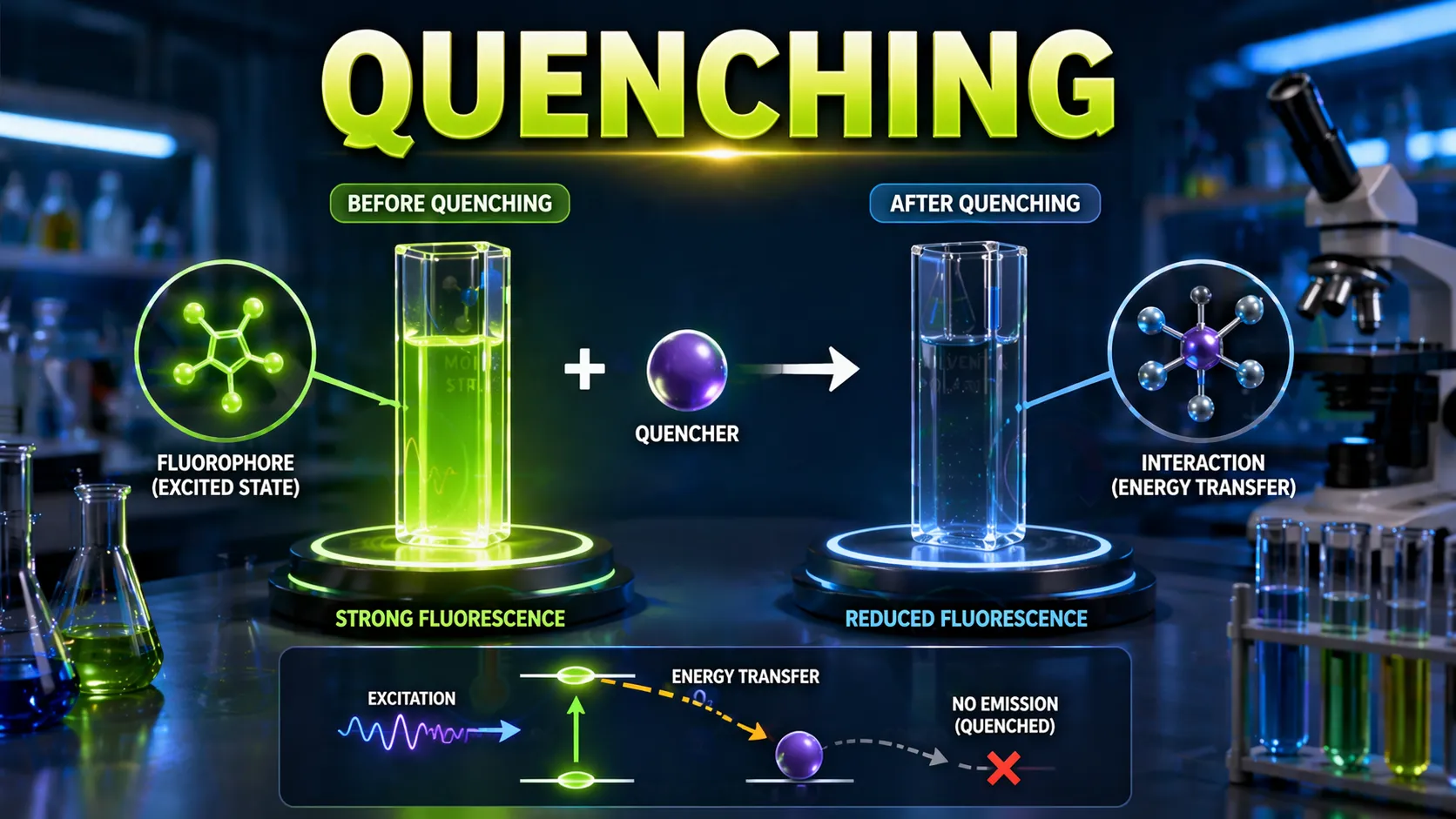
Definition of Quenching
- It refers to any process that decreases the fluorescence intensity of a sample.
- It can be due to various mechanisms, both dynamic and static.
Types

-
Dynamic (Collisional)
- Mechanism: Occurs when the excited fluorophore collides with a quencher molecule, returning to the ground state without emitting a photon.
- Temperature Dependence: Increases with temperature due to higher collision frequencies.
-
Static
- Mechanism: Formation of a non-fluorescent ground-state complex between the fluorophore and quencher before excitation.
- Concentration Dependence: Increases with the concentration of quencher.
-
Self-Quenching and Self-Absorption
- Self-Quenching: Fluorophore molecules quench each other’s fluorescence at high concentrations.
- Self-Absorption: Emitted photons are reabsorbed by other fluorophore molecules.
-
Energy Transfer
- Förster Resonance Energy Transfer (FRET): Non-radiative transfer of excitation energy from a donor to an acceptor molecule.
Implications
- Analysis: Quenching studies can provide information on molecular interactions and distances.
- Applications: Used in biochemical assays to study protein folding, ligand binding, and conformational changes.
Advertisements
Factors Influencing:
- Quencher Concentration: Higher concentrations enhance its efficiency.
- Temperature: Increases dynamic quenching due to faster diffusion; reduces static quenching by lowering complex formation.
- Solvent Viscosity: Higher viscosity slows mobility, reducing collisional quenching.
- Spectral Overlap: Greater overlap improves FRET efficiency and energy transfer rates.