
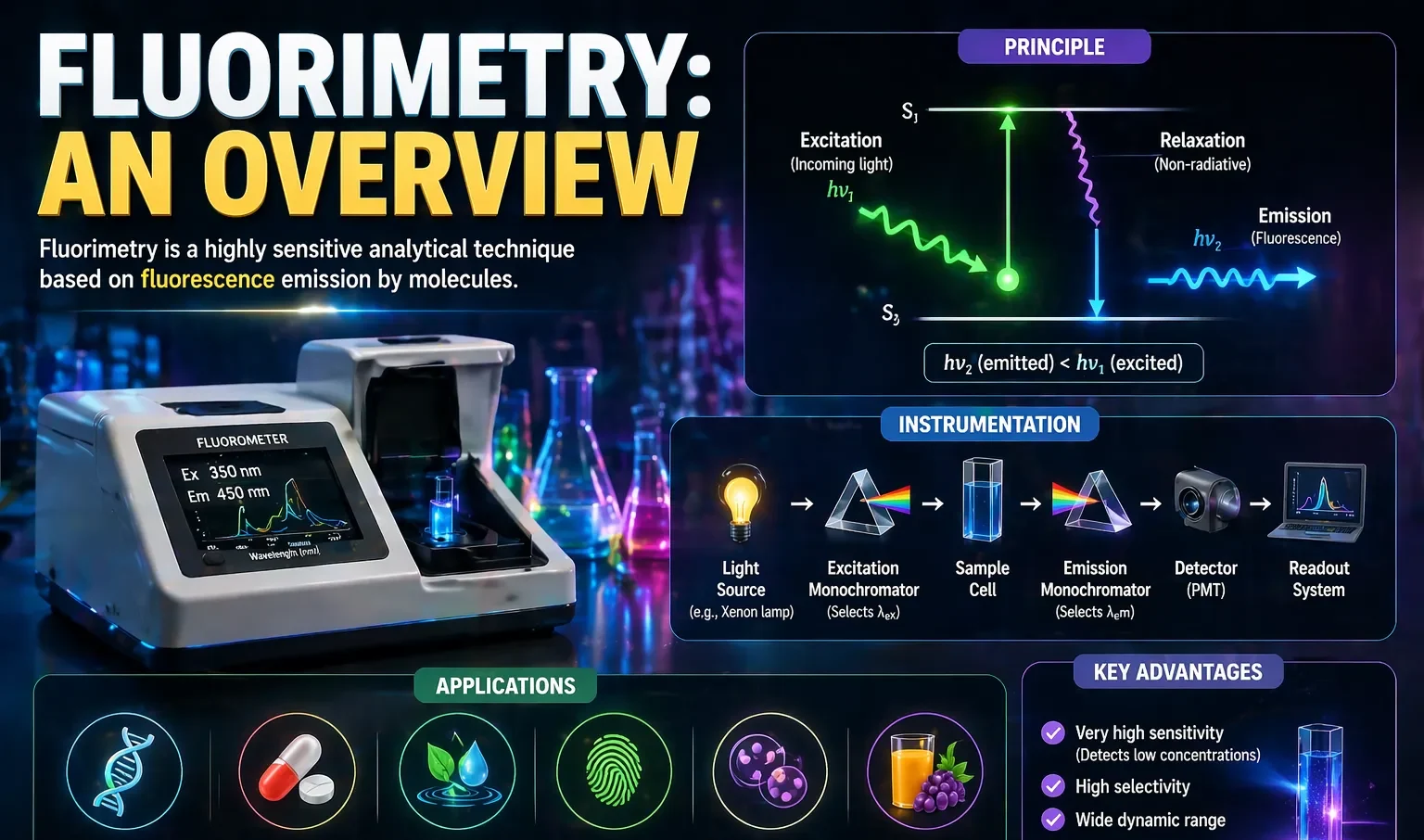
Definition of Fluorimetry:
- Fluorimetry measures fluorescence emitted by a substance after absorbing light or radiation.
- It involves exciting molecules to higher energy states and detecting the light emitted as they return to lower energy states.
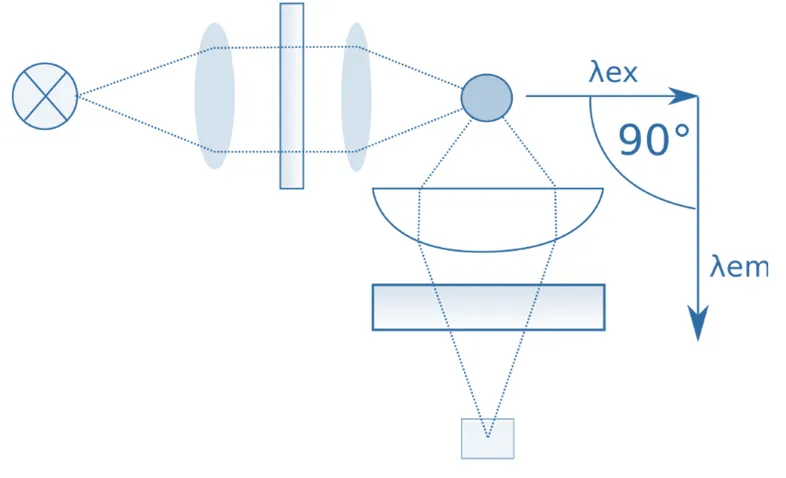
Principle:
- A fluorophore absorbs photons, exciting its electrons to higher states.
- As electrons return to the ground state, they emit lower-energy (longer wavelength) photons.
- The emitted light’s intensity and characteristics reveal information about the fluorophore’s environment, concentration, and interactions.
Advertisements
Key Characteristics:
- High Sensitivity: Detects very low concentrations.
- Selectivity: Distinguishes fluorophores by their unique excitation and emission wavelengths.
- Dynamic Range: Measures a wide concentration range.
- Non-Destructive: Preserves sample integrity during analysis.
Components:
- Excitation Source: UV or visible light source to excite molecules.
- Monochromator: Selects specific excitation wavelengths.
- Sample Cell: Holds the sample for analysis.
- Emission Monochromator: Filters emitted light to isolate desired wavelengths.
- Detector: Measures the intensity of emitted fluorescence.
Applications in Pharmaceuticals:
- Quantification: Measures concentrations of naturally fluorescent drugs.
- Complex Mixtures: Fluorescent tagging makes non-fluorescent molecules detectable.
- Kinetic Studies: Tracks reaction rates via fluorescence changes.
- Impurity Detection: Identifies trace fluorescent impurities undetectable by other methods.
Advertisements
Advantages:
- High Sensitivity: Detects very low concentrations.
- Selectivity: Differentiates compounds by unique excitation and emission wavelengths.
Limitations:
- Limited to fluorescent compounds or those that can be tagged.
- Fluorescence influenced by pH, temperature, and quenching agents.
Click Here to Watch the Best Pharma Videos
Advertisements