
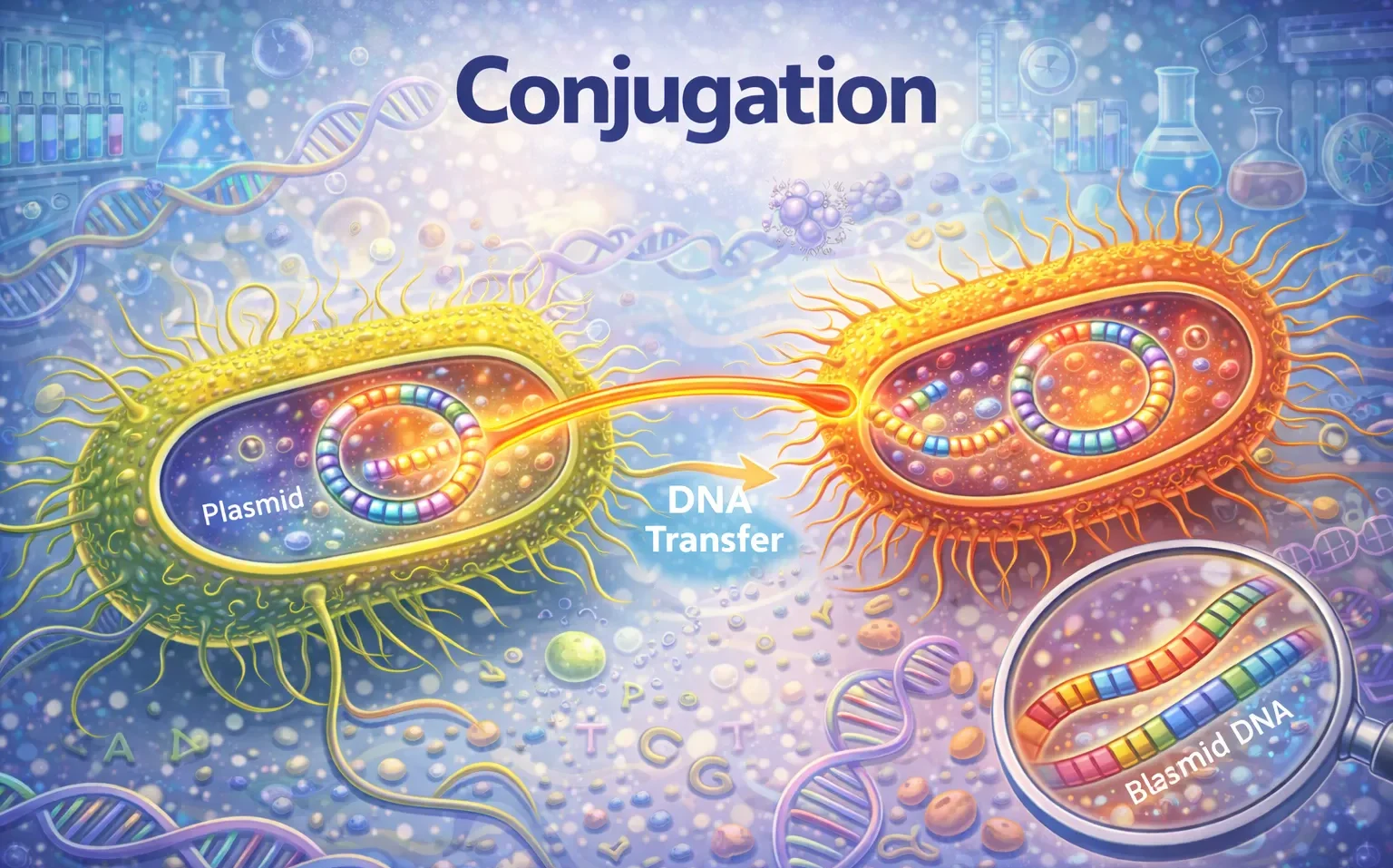
Conjugation explains mechanism F plasmid role steps and importance in bacterial gene transfer and recombination.
Definition:
- Conjugation is the direct transfer of genetic material between bacteria through cell-to-cell contact using a specialized structure called a pilus (sex pilus).
Mechanism of Conjugation:
- Formation of a Pilus: The donor bacterium (F⁺) extends a pilus to connect with the recipient bacterium (F⁻).
- DNA Transfer: The plasmid DNA (usually the F-plasmid) is replicated and transferred to the recipient.
- Recipient Becomes Donor: The recipient (F⁻) becomes an F⁺ cell after receiving the plasmid, enabling it to further transfer the plasmid to other bacteria.
Advertisements
Types of Conjugation:
-
F-plasmid
- The donor cell (F⁺) contains an F-plasmid that encodes genes for conjugation.
- Transfers the F-plasmid to an F⁻ recipient, converting it into an F⁺ donor.
-
Hfr
- The F-plasmid integrates into the bacterial chromosome, forming an Hfr (high-frequency recombination) cell.
- Transfers part of the chromosomal DNA along with the plasmid.
Advertisements
Significance:
- It is a major mechanism for the spread of antibiotic resistance genes (e.g., R-plasmids carrying resistance genes).
- Facilitates genetic recombination and evolution in bacterial populations.
Click Here to Watch the Best Pharma Videos
Advertisements