
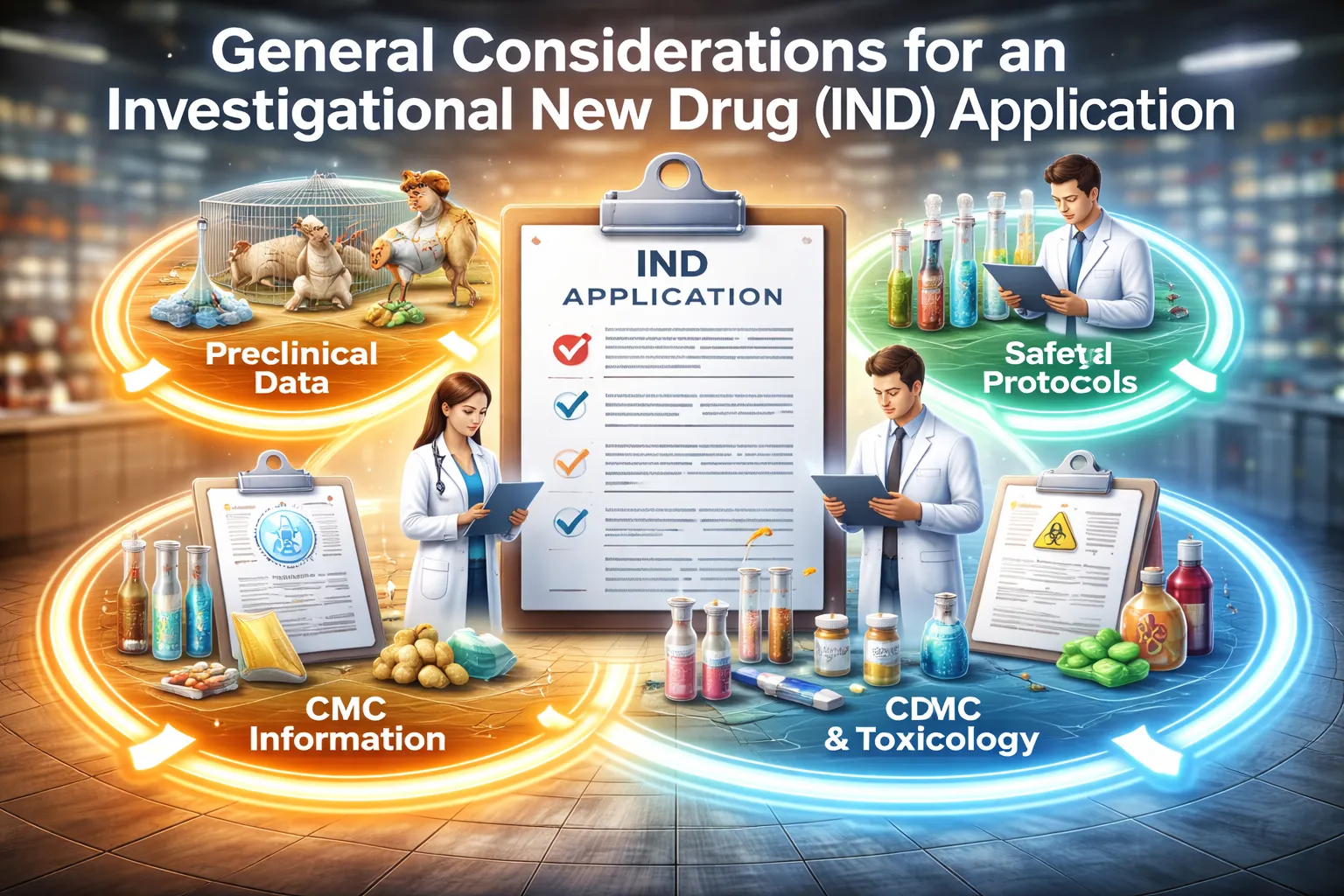
General Considerations for an Investigational New Drug (IND) Application ensure safety and compliance before clinical trials.
General Considerations for an Investigational New Drug (IND) Application
- The Investigational New Drug (IND) application is a critical step in drug development, allowing a pharmaceutical company to conduct clinical trials on a new drug in humans.
- Submitted to regulatory authorities (e.g., the FDA in the U.S.), the IND demonstrates that a drug is safe for human testing.
Purpose of the IND Application
- To confirm the drug’s safety profile for human trials by providing data on its composition, manufacturing, preclinical studies, and proposed clinical protocols.
Advertisements
Key Components of an IND Application
-
Preclinical Data
- Includes: Pharmacology and toxicology studies.
- Purpose: Shows the drug’s mechanism of action and safety profile to establish safe dosage levels.
-
Chemistry, Manufacturing, and Controls (CMC)
- Includes: Composition, manufacturing, processing, packaging, and storage details.
- Purpose: Ensures the investigational drug’s consistent quality for clinical trials.
-
Clinical Protocol and Study Plans
- Includes: Initial phase (Phase I) clinical trial plans with objectives, design, methodology, and safety monitoring.
-
Investigator Information
- Purpose: Confirms qualifications of clinical investigators to ensure trials are conducted by qualified personnel.
-
Institutional Review Board (IRB) Information
- Purpose: Assures ethical review and approval of trials by the IRB for participant protection.
Types of IND Applications

-
Investigator IND
- Purpose: Initiated by a physician to study an unapproved drug or new indication.
- Key Consideration: The investigator assumes the sponsor’s role and ensures FDA requirements are met.
-
Emergency Use IND
- Purpose: Allows experimental drug use in urgent situations without prior IND submission.
- Key Consideration: Justification provided promptly, focusing on immediate patient benefits over risks.
-
Treatment IND
- Purpose: Allows promising experimental drugs to be used for serious conditions during ongoing trials and FDA review.
- Key Consideration: Evidence of efficacy, safety, and lack of alternatives must be demonstrated.
-
Screening IND
- Purpose: Enables early human testing for multiple related drugs under a single IND.
- Key Consideration: Useful for sponsors evaluating several candidates before committing to full development.
Advertisements
General Considerations for the IND Application
- Safety: Ensuring the drug poses no unreasonable risk to human subjects.
- Regulatory Compliance: Adhering to all regulatory standards and guidelines.
- Quality Control: Maintaining high manufacturing quality to ensure drug consistency.
- Ethical Considerations: Conducting ethically sound studies that protect participants.
- Scientific Validity: Designing trials that yield reliable, interpretable data.
- Risk/Benefit Analysis: Assessing the potential risks and benefits to justify human testing.
The IND application is essential for regulatory approval to advance a drug from laboratory research to clinical testing, with a focus on safety, compliance, and scientific rigor.
Click Here to Watch the Best Pharma Videos
Advertisements