
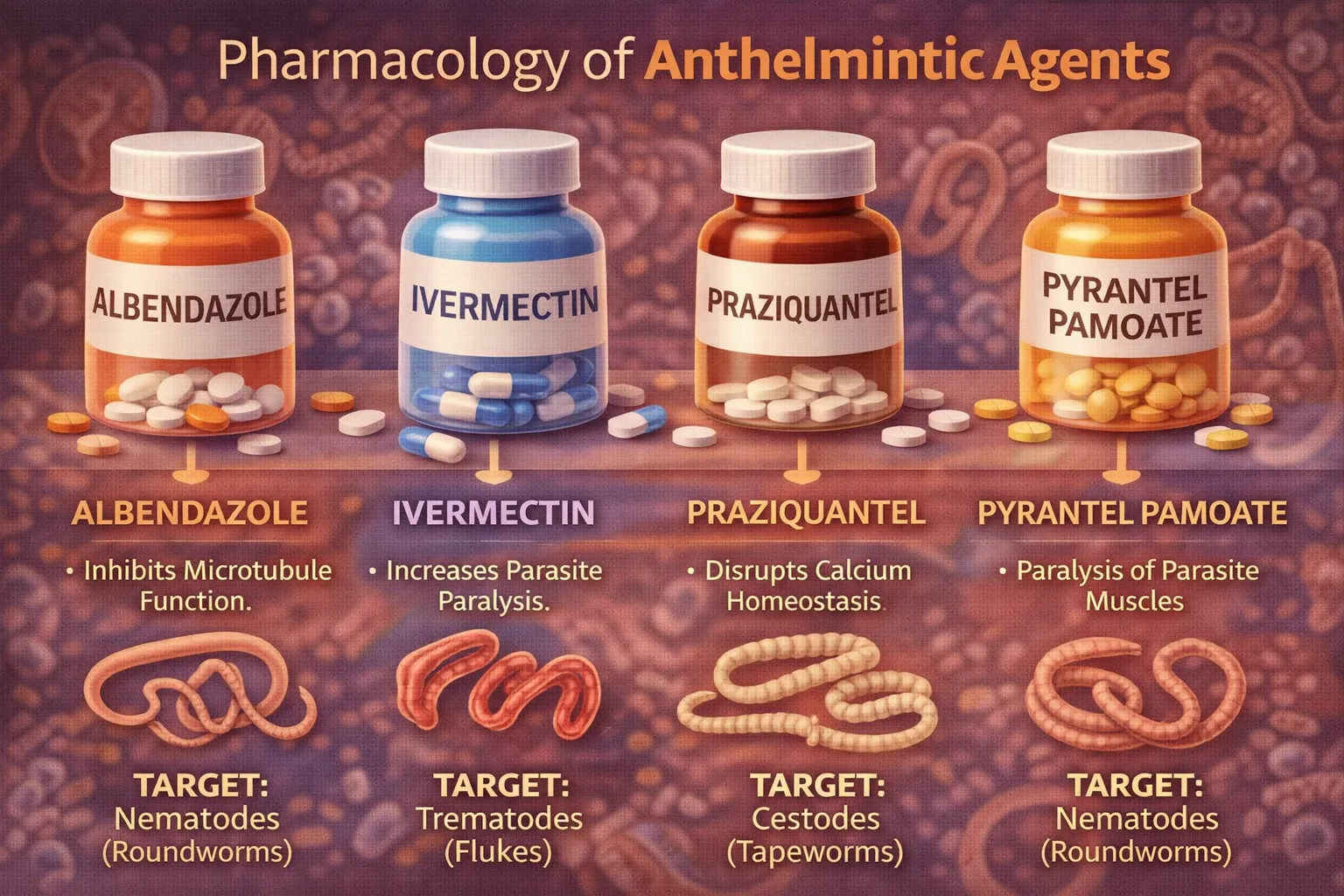
Pharmacology of Anthelmintic Agents explains mechanisms and actions of drugs used to kill or expel parasitic worms.
Pharmacology of Anthelmintic Agents
- Helminths (worms) infect the intestinal tract, tissues, or blood. Anthelmintic drugs either paralyze or kill the parasites, leading to their expulsion.
Types of Helminths
- Nematodes (roundworms)
- Cestodes (tapeworms)
- Trematodes (flukes)
Advertisements
Main Anthelmintic Drugs

Advertisements
-
Benzimidazoles
- Examples: Albendazole, Mebendazole
- Mechanism: Inhibit microtubule polymerization → disrupt glucose uptake → death
- Use: Broad-spectrum → roundworms, hookworms, pinworms, tapeworms
- Note: Albendazole preferred in hydatid disease
-
Pyrantel Pamoate
- Mechanism: Depolarizing neuromuscular blocker → paralysis
- Use: Roundworms, pinworms, hookworms
-
Ivermectin
- Mechanism: Enhances GABA transmission → paralysis
- Use: Filariasis, strongyloidiasis, onchocerciasis (river blindness)
-
Praziquantel
- Mechanism: Increases calcium permeability → spastic paralysis
- Use: Tapeworms (cestodes), flukes (trematodes), schistosomiasis
-
Diethylcarbamazine (DEC)
- Mechanism: Immobilizes microfilariae
- Use: Filariasis (W. bancrofti)
Pharmacokinetics
| Parameter | Key Details |
| Absorption | Usually oral; affected by food and gastric pH |
| Distribution | May concentrate in tissues (e.g., liver, fat) |
| Metabolism | Some metabolized in the liver; others excreted unchanged |
| Elimination | Mainly via urine or feces |
| Half-life | Varies: from hours (e.g., pyrantel) to days (e.g., ivermectin) |
Note: Pharmacokinetics vary with patient age, weight, organ function, and concurrent medications.
Advertisements