

- Polymerase Chain Reaction (PCR) is a widely used molecular biology technique that enables the amplification of a specific DNA fragment from a complex mixture of DNA.
- It was developed in the 1980s by Kary Mullis and has since become an essential tool in biological research, medical diagnostics, and forensic analysis.
Why is PCR Important?
- PCR offers several advantages that make it indispensable in various scientific and medical fields:
- Highly Sensitive → Can amplify even a single DNA molecule.
- Rapid → Millions of DNA copies can be generated within a few hours.
- Specific → Targets and amplifies only the desired DNA sequence.
- Versatile → Used in applications such as forensic science, medical diagnosis, and genetic research.
Advertisements
Basic Principle of PCR
- PCR works by mimicking natural DNA replication but in a controlled lab environment using temperature cycles and a heat-stable DNA polymerase enzyme.
Main Components of PCR
- Template DNA → The DNA containing the sequence to be amplified.
- Primers → Short single-stranded DNA sequences that bind to the target DNA.
- DNA Polymerase → An enzyme (e.g., Taq polymerase) that synthesizes new DNA strands.
- dNTPs (Deoxynucleotide Triphosphates) → Building blocks of new DNA strands (A, T, G, C).
- Buffer Solution → Maintains optimal conditions for enzyme activity.
Types of PCR
PCR techniques vary depending on the application and precision required:
Advertisements
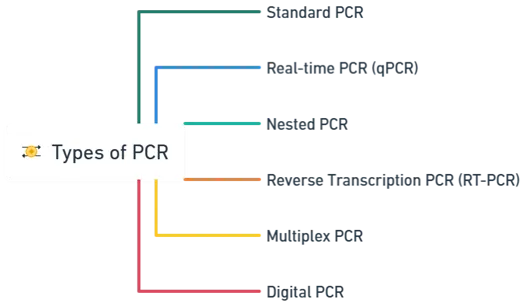
- Standard PCR → The most common type, used to amplify a target DNA sequence.
- Real-time PCR (qPCR) → Detects and quantifies DNA in real-time, useful for gene expression analysis, viral load determination, and genetic testing.
- Nested PCR → A two-stage process using nested primers for improved specificity.
- Reverse Transcription PCR (RT-PCR) → Converts RNA into complementary DNA (cDNA) before amplification, allowing gene expression detection.
- Multiplex PCR → Amplifies multiple target DNA sequences in a single reaction using multiple primer sets.
- Digital PCR → Partitions a DNA sample into multiple reactions for precise DNA quantification.
Steps Involved in PCR
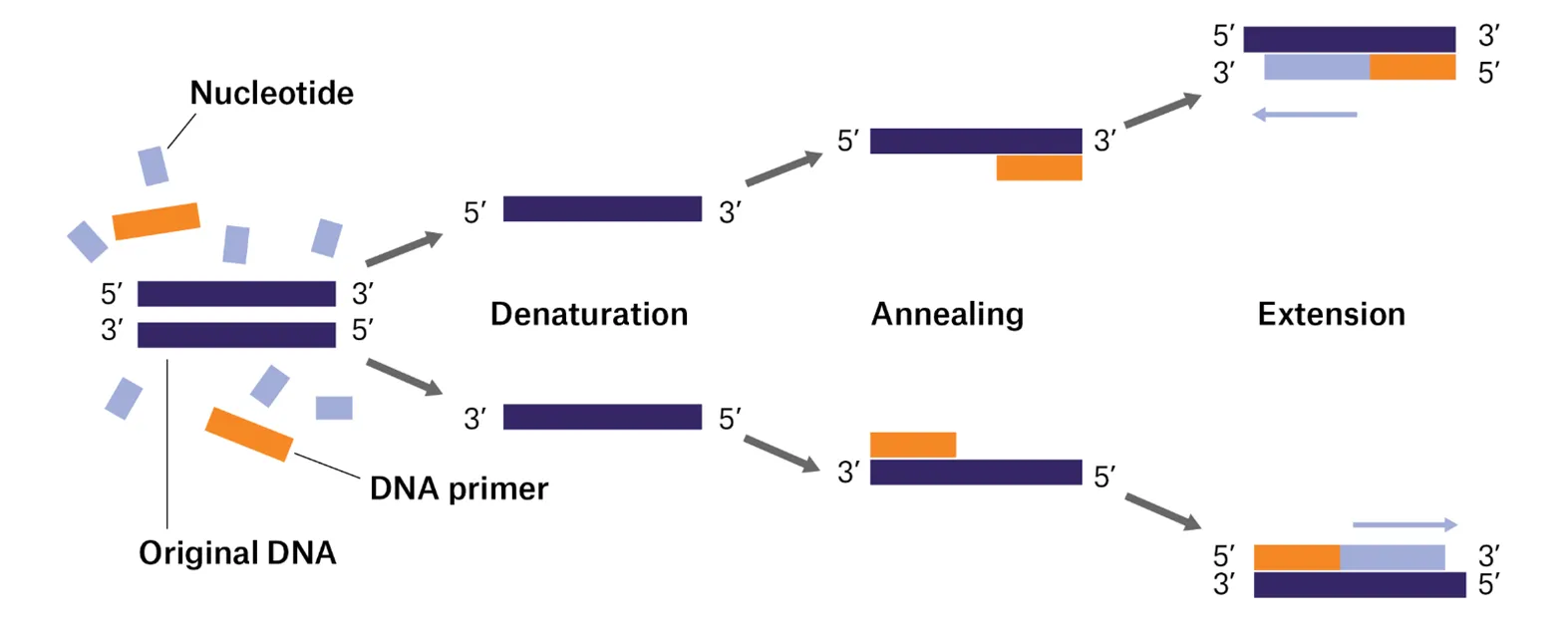
- PCR consists of three main steps, repeated in cycles to amplify DNA exponentially:
-
Denaturation (95°C)
- The double-stranded DNA is heated to separate the strands.
-
Annealing (50–65°C)
- Primers bind to the template DNA at specific sites, marking the start and end points of the target sequence.
-
Extension (72°C)
- DNA polymerase (e.g., Taq polymerase) adds nucleotides to extend the DNA strand.
-
Repeat Cycles
- The denaturation, annealing, and extension steps are repeated for 20–40 cycles, exponentially increasing the amount of DNA.
-
- The final product is a large quantity of amplified DNA, which can be used for further applications.
Advertisements
Applications of PCR
- Medical Diagnosis → Detects genetic diseases, viral infections (e.g., COVID-19, HIV).
- Forensic Science → DNA fingerprinting for crime investigations.
- Molecular Biology Research → Gene cloning, mutation analysis.
- Paternity Testing → Establishes biological relationships