
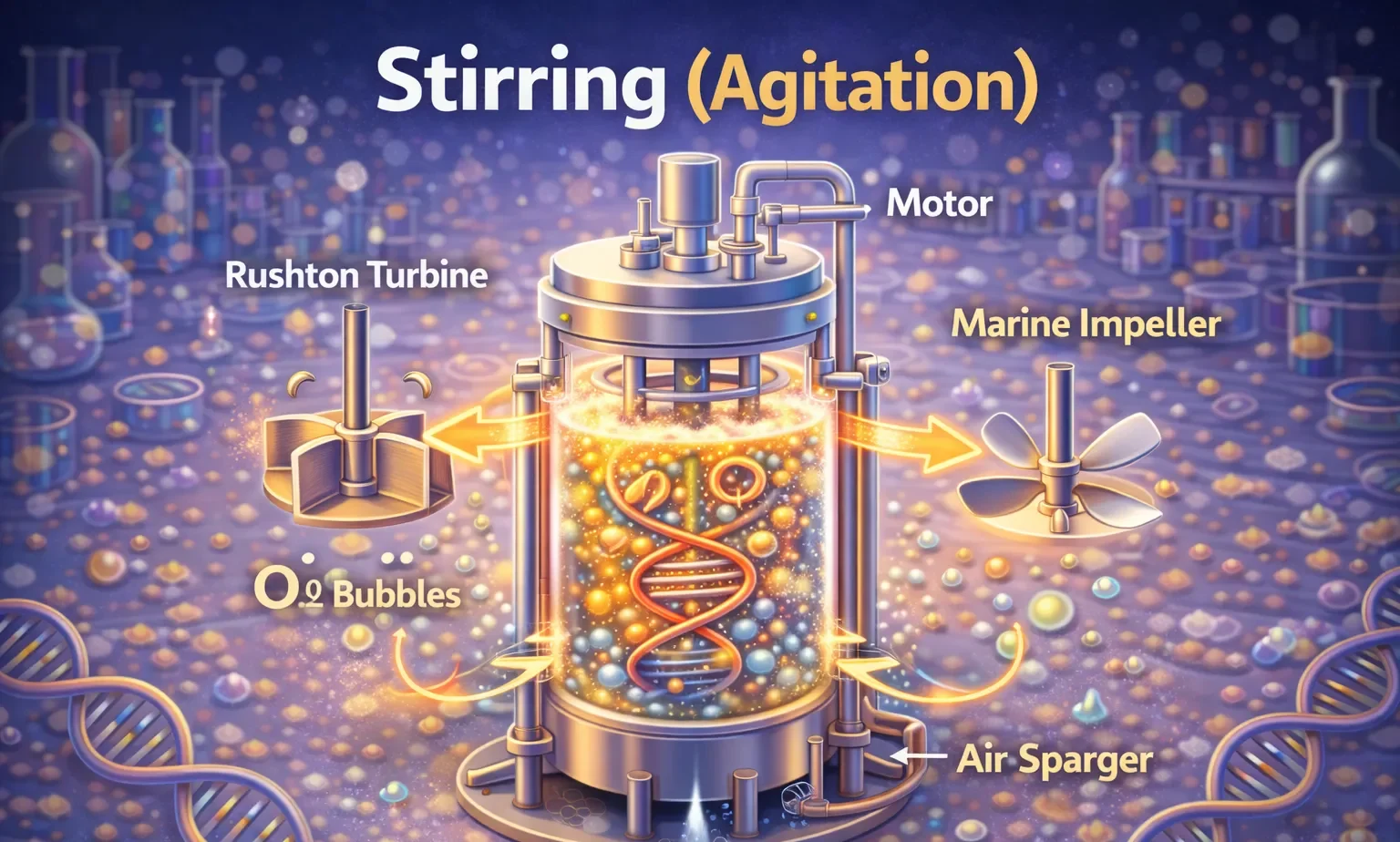
Stirring (Agitation) explains principles equipment mixing efficiency and role in oxygen transfer during fermentation.
Importance of Stirring
- Uniform Mixing: Ensures even distribution of nutrients, microorganisms, and temperature.
- Enhanced Mass Transfer: Facilitates oxygen transfer from air bubbles to cells.
- Heat Transfer: Aids in distributing heat uniformly, preventing temperature gradients.
Types of Stirring Systems

Advertisements
-
Impellers (Mechanical Agitators)
- Rushton Turbine: Flat-blade disk impeller, common for gas-liquid dispersion.
- Marine Propeller: Efficient for low-viscosity liquids; large blade area.
- Paddle Impeller: Simpler design, often used in low-shear conditions.
-
Airlift Fermenters
- Rely on air sparging instead of mechanical stirring.
- Circulation is driven by the difference in density between the aerated and non-aerated zones.
Key Parameters in Stirring
- Agitation Speed (rpm): Must be optimized to ensure proper mixing without damaging shear-sensitive cells.
- Power Consumption: Stirring can be a major energy cost; large-scale setups must balance oxygen transfer needs with efficiency.
- Shear Sensitivity: Certain cells (e.g., animal cells, filamentous fungi) can be damaged by high shear forces.
Common Stirring Instruments
- Impellers – Rotating blades that generate turbulence.
- Propellers – Smaller, simpler versions of impellers.
- Magnetic Stirrers – Use a rotating magnetic field to move a stirrer bar.
- Air-Lift Fermenters – Rely on air bubbles for mixing.
- Bioreactors – Large vessels with mechanical stirring mechanisms like impellers or propellers.
Advertisements