
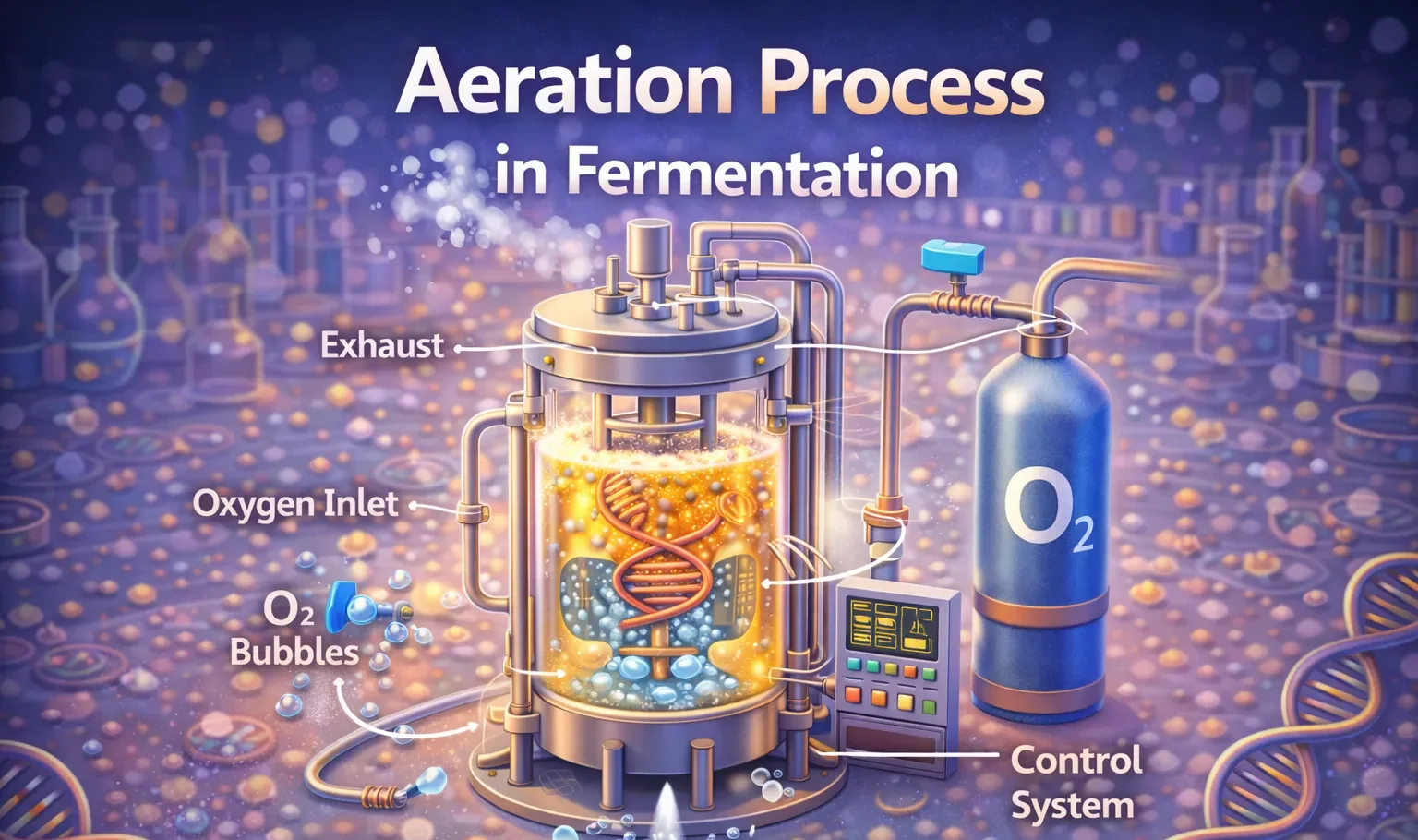
Aeration Process in Fermentation
Aeration Process in Fermentation explains principles oxygen transfer methods equipment and role in microbial growth.
Role of Aeration
Aeration ensures adequate oxygen supply for microbial growth and metabolism. Key functions:
- Oxygen Supply: Essential for aerobic and facultative microorganisms.
- Maintaining Dissolved Oxygen (DO): Must stay above a critical threshold for metabolism.
Advertisements
Methods of Aeration

-
Sparging (Bubble Aeration)
- Compressed air (or pure oxygen) is introduced at the base of the fermenter through a sparger (e.g., sintered metal, perforated pipes).
- Bubbles supply oxygen and help mix the culture.
-
Surface Aeration
- In smaller-scale fermentations (e.g., shaking flasks), oxygen is transferred from the headspace as the liquid is agitated.
-
Headspace Oxygen Control
- Some systems adjust the oxygen partial pressure in the headspace above the medium, useful in large-scale continuous processes.
Types of Aeration
- Surface Aeration – Air is introduced at the surface, suitable for lab-scale fermentations.
- Submerged Aeration – Air or oxygen is introduced below the surface, ideal for large-scale aerobic fermentation.
Advertisements
Factors Influencing Oxygen Transfer
- Agitation Speed: Higher stirring increases bubble dispersion, improving oxygen transfer.
- Viscosity of the Medium: Higher viscosity limits oxygen solubility and transfer rate.
- Antifoaming Agents: Excess foam can hinder oxygen transfer; antifoaming agents reduce foam but can also affect mass transfer.