
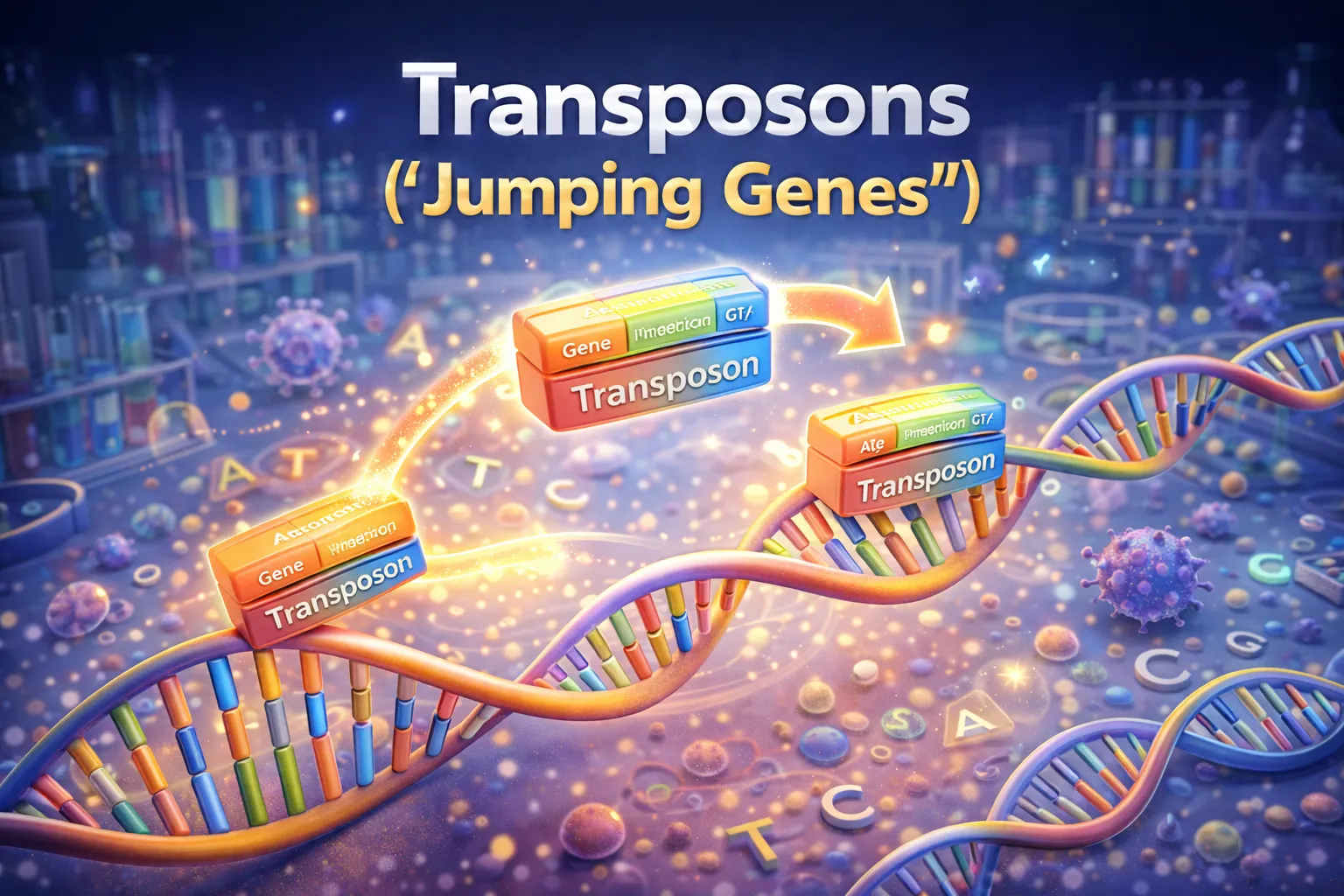
Transposons (“Jumping Genes”) explain structure types movement mechanism and role in gene regulation and mutation.
Definition of Transposons (“Jumping Genes”):
- Transposons are mobile genetic elements that can move within the genome, from one location to another, or between chromosomes and plasmids.

Advertisements
Types of Transposons:
-
Insertion Sequences (IS Elements):
- The simplest transposons, containing only genes for transposase (an enzyme that catalyzes movement).
- Example: IS1 in coli.
- The simplest transposons, containing only genes for transposase (an enzyme that catalyzes movement).
-
Composite Transposons:
- Contain additional genes (e.g., antibiotic resistance genes) between two insertion sequences.
- Example: Tn10 (carries tetracycline resistance).
- Contain additional genes (e.g., antibiotic resistance genes) between two insertion sequences.
-
Replicative Transposons:
- Create a copy of themselves and insert it elsewhere in the genome.
-
Conjugative Transposons:
- Can move between bacteria through conjugation and spread resistance genes.
Advertisements
Mechanism of Transposition:
- The transposase enzyme recognizes specific sequences and cuts the transposon out of its original location.
- The transposon is then inserted into a new location within the genome or a plasmid.
Significance of Transposons (“Jumping Genes”):
- Cause mutations by disrupting genes when they insert into new locations.
- Contribute to genetic variation and evolution.
- Help in the spread of antibiotic resistance genes among bacteria.
Advertisements