
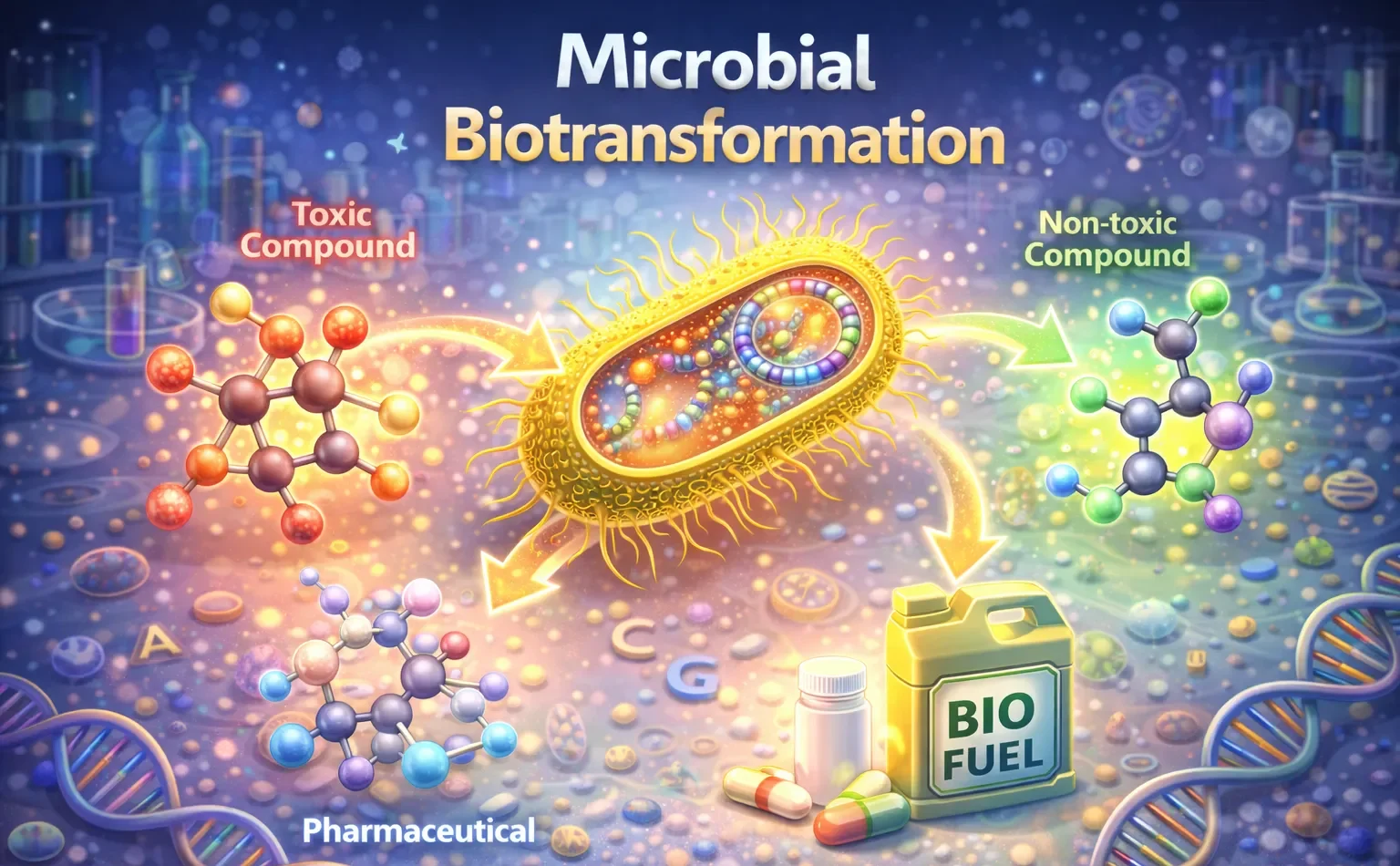
Microbial Biotransformation explains mechanisms types enzymes and applications in drug metabolism and industrial biotechnology.
Introduction
- Microbial biotransformation, also known as microbial metabolism or biocatalysis, refers to the process in which microorganisms, such as bacteria, fungi, and yeasts, transform organic compounds into more desirable products.
- This process is widely used in various industries, including pharmaceuticals, agriculture, and biotechnology, for the production of valuable products such as:
- Drugs (e.g., antibiotics, anticancer drugs)
- Food additives (e.g., flavors, sweeteners)
- Biofuels
- Fragrances and chemicals
Types of Microbial Biotransformation
-
Phase I Biotransformation
- Involves the introduction of functional groups, such as hydroxyl (-OH), carboxyl (-COOH), or amino (-NH₂), to the original compound.
- Carried out by monooxygenases or cytochrome P450 enzymes.
- Increases the compound’s reactivity, making it more susceptible to further modification in Phase II.
- May result in the formation of toxic metabolites requiring additional processing.
-
Phase II Biotransformation
- Involves the conjugation of functional groups introduced in Phase I with endogenous compounds such as glutathione, sulfate, or glucuronic acid.
- Produces more polar and water-soluble compounds for easier excretion.
- Carried out by transferase enzymes and requires ATP hydrolysis.
- Primarily functions as a detoxification
Advertisements
Steps in Microbial Biotransformation
-
Substrate Selection
- The substrate is the starting material that undergoes transformation.
- Must be compatible with the selected biocatalyst.
-
Biocatalyst Selection
- The biocatalyst is the enzyme or microorganism responsible for the reaction.
- Should have high efficiency and specificity for the desired transformation.
-
Optimization of Reaction Conditions
- Factors such as temperature, pH, substrate, and biocatalyst concentration must be optimized for maximum yield.
-
Purification of the Product
- After biotransformation, the product is purified from remaining substrates or by-products to meet quality standards.
Advantages of Microbial Biotransformation
- High Selectivity – Microorganisms selectively transform substrates with high efficiency.
- Mild Reaction Conditions – Operates at ambient temperature and pressure, reducing energy costs.
- Enzyme Recycling – Use of immobilized enzymes allows for recycling and improved efficiency.
- Diversity of Microbial Species – A wide variety of microbial species offer different enzymatic capabilities.
Disadvantages
- Complexity – Involves multiple enzymatic steps, increasing cost and time.
- Genetic Variability – Differences in microbial strains affect reproducibility.
- Sterility Requirements – Requires sterile conditions to prevent contamination, increasing cost.
Advertisements
Applications of Microbial Biotransformation
- Pharmaceutical Industry – Production of antibiotics, steroids, and anticancer drugs.
- Food and Beverage Industry – Production of food additives, flavors, and fermentation of beverages.
- Chemical Industry – Production of biofuels, solvents, and biodegradable plastics.
- Environmental Applications – Biodegradation of pollutants like oil spills and wastewater treatment.