
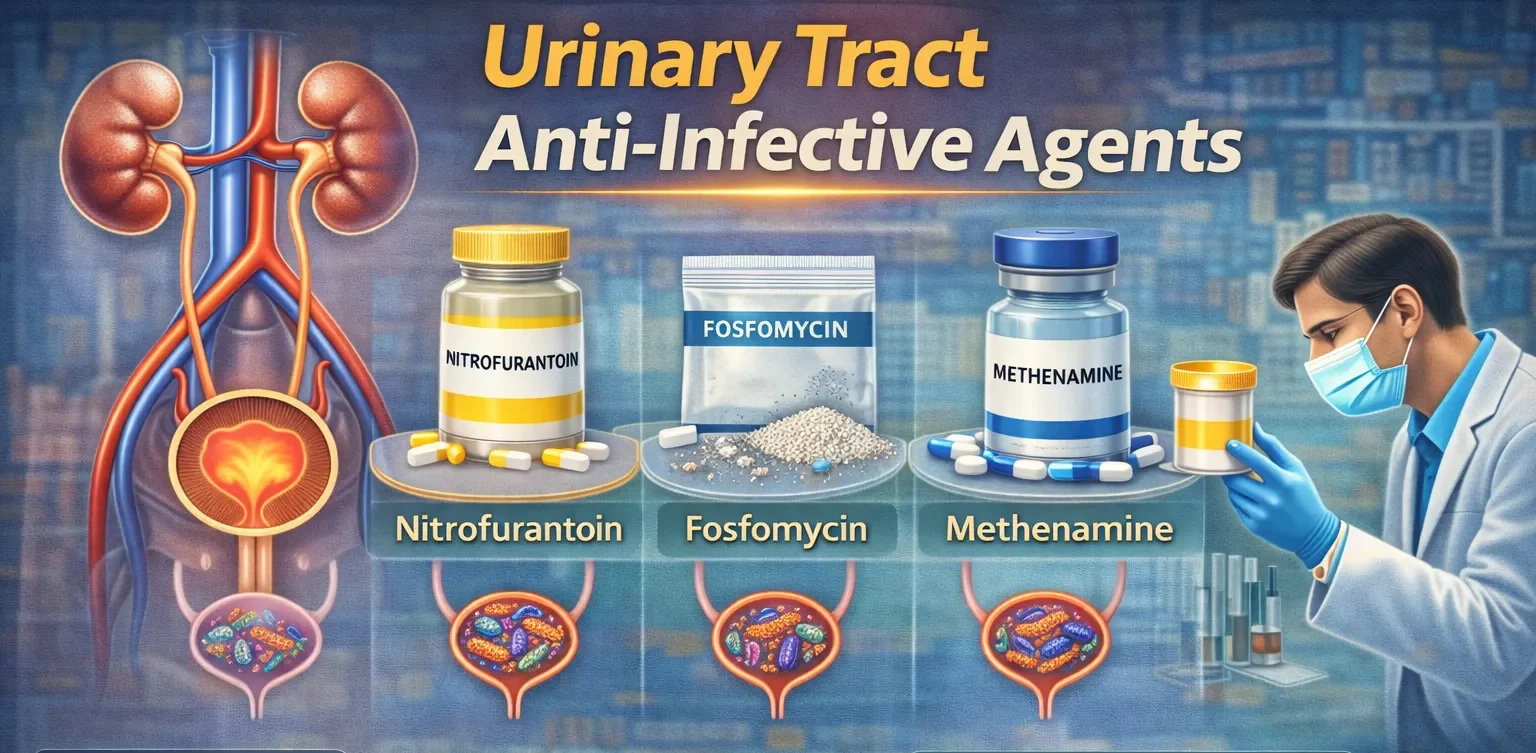
Urinary Tract Anti-Infective Agents
- Urinary tract anti-infective agents are used to treat bacterial infections of the urinary tract, such as cystitis, pyelonephritis, and urethritis.
- These agents are classified based on their mechanism of action and chemical structure.
1. Quinolones (Fluoroquinolones)
- These drugs act by inhibiting bacterial DNA gyrase and topoisomerase IV, leading to DNA damage and bacterial cell death.
Examples:
Advertisements
SAR Summary of Quinolones
| Position | Structural Feature | SAR Insight |
| C1 | N-substitution (e.g., cyclopropyl, ethyl) | Cyclopropyl enhances Gram-positive activity and broadens spectrum (e.g., ciprofloxacin). |
| C3 & C4 | Carboxylic acid and ketone | Essential for binding to bacterial DNA-topoisomerase complex via Mg²⁺ bridge. Any modification reduces activity. |
| C5 | H or –NH₂ / –OH | Substitutions can enhance Gram-positive activity (e.g., OH improves activity but may increase toxicity). |
| C6 | Fluorine atom (F) | Enhances lipophilicity, cell penetration, and enzyme inhibition. Characteristic of fluoroquinolones. |
| C7 | Piperazine or similar heterocyclic ring | Enhances activity against Gram-negative bacteria. Affects CNS side effects and resistance. |
| C8 | Methoxy or halogen (F, Cl) | Affects phototoxicity and anaerobic activity. Methoxy at C8 (e.g., moxifloxacin) reduces phototoxicity. |
2. Miscellaneous Urinary Tract Anti-Infectives
- These agents have varied mechanisms of action, including inhibition of bacterial enzymes, induction of oxidative stress, and acidification of urine, which suppress bacterial growth.
Advertisements
Examples:
-
- Furazolidone
- Nitrofurantoin*
- Methenamine

Advertisements