
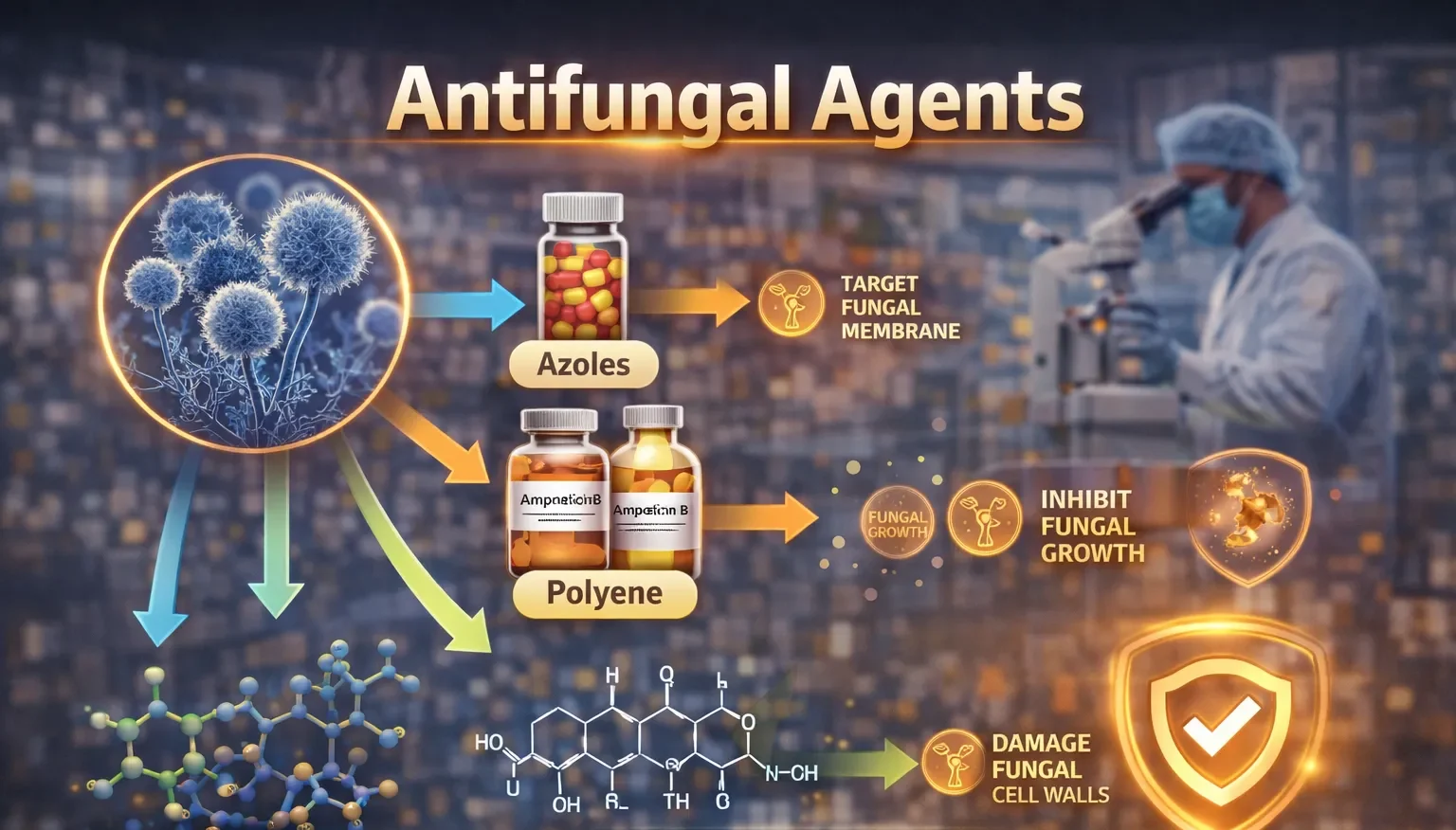
- Antifungal agents treat fungal infections by targeting the cell wall, cell membrane, or intracellular components to inhibit fungal growth.
Mechanisms of Action
-
Cell Wall-Targeting Agents
- Inhibit beta-glucan synthesis, weakening the fungal cell wall.
- Examples: Echinocandins (caspofungin, anidulafungin).
-
Cell Membrane-Targeting Agents
- Disrupt ergosterol synthesis, compromising membrane integrity.
- Examples:
- Azoles: Fluconazole, Itraconazole.
- Polyenes: Amphotericin B.
-
Intracellular Component-Targeting Agents
- Inhibit nucleic acid synthesis (e.g., flucytosine) or cell wall synthesis (e.g., terbinafine).
Classification
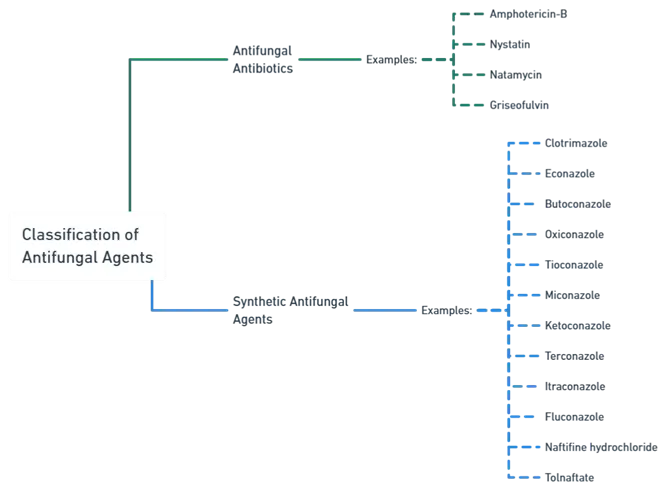
They can be broadly classified into two categories:
-
Antifungal Antibiotics:
- These are naturally derived antifungal agents produced by microorganisms.
- Examples include:
- Amphotericin-B
- Nystatin
- Natamycin
- Griseofulvin
-
Synthetic Antifungal Agents:
- These are chemically synthesized antifungal drugs used for various fungal infections.
- Examples include:
- Clotrimazole
- Econazole
- Butoconazole
- Oxiconazole
- Tioconazole
- Miconazole
- Ketoconazole
- Terconazole
- Itraconazole
- Fluconazole
- Naftifine hydrochloride
- Tolnaftate